
In partnership with


The Greater Boston Food Bank (GBFB) distributes more than 110 million pounds of food annually, equivalent to about 92 million meals. (Photo by Rosanna Marinelli/The Latino Newsletter)
Editor’s Note: Para la versión en español de este artículo, visita El Planeta.
BOSTON — Since the start of the COVID-19 pandemic, more than two million servings of fish chowder and stew have been distributed across Massachusetts. Some batches are classic New England chowder, creamy and traditional, while others are tomato-based stews infused with vegetables and spices familiar to many Brazilian, Latino, and immigrant families.
For Seth Rolbein, senior policy analyst at the Cape Cod Commercial Fishermen’s Alliance, a member-based organization that works with fishermen up and down the coast, that mission resonates strongly in Cape Cod, where a significant Brazilian community is present.

What began as a local effort quickly grew into a statewide priority for the Greater Boston Food Bank (GBFB), one of the largest food banks in the country and the largest hunger-relief organization in New England, which distributes more than 110 million pounds of food each year across the region. Through GBFB’s statewide network, the “Small Boats, Big Taste” program now reaches food pantries across Massachusetts — from Cape Cod to Worcester, Springfield, and the Merrimack Valley — while Rolbein works to ensure the meals reflect the cultural traditions of the communities served.
“If you truly want to be revolutionary, then we must come together and end hunger here and now,” GBFB President and CEO Catherine D’Amato said.

Catherine D’Amato, President and CEO of GBFB (Photo by Rosanna Marinelli/The Latino Newsletter)
Food Insecurity Continues to Rise
The approach comes as food insecurity continues to rise across Massachusetts.
GBFB’s latest Food Access Report found that in 2025, food insecurity was more than double the 2019 rate, with Hispanic households remaining the most affected for the sixth consecutive year, at 63% reporting unreliable access to enough food.
At Massachusetts General Brigham for Children, pediatric gastroenterologist Dr. Lauren Fiechtner has been tracking these changes since the beginning of the pandemic. As the senior health and research advisor at GBFB, she has helped lead statewide research examining how food insecurity is shaped by persistent barriers, including rising costs, uneven wages, fear and confusion around public assistance programs, and limited access to healthy food.
“We know healthy food works,” Dr. Fiechtner said. “The challenge is making sure people can access it in a way that feels dignified, familiar, and useful in their daily lives.”
Still, she emphasized that the state’s food system is increasingly adapting to meet communities where they are. GBFB has institutionalized culturally relevant food access through initiatives such as the Takeda Center for Community Health and Nutrition, launched this year with a $4 million donation to expand culturally responsive food distribution.
“We don’t tell our clients what they have to take,” GBFB Chief Operating Officer Cheryl Schondek said. “If your community wants tomatillos, we’ll get them.”
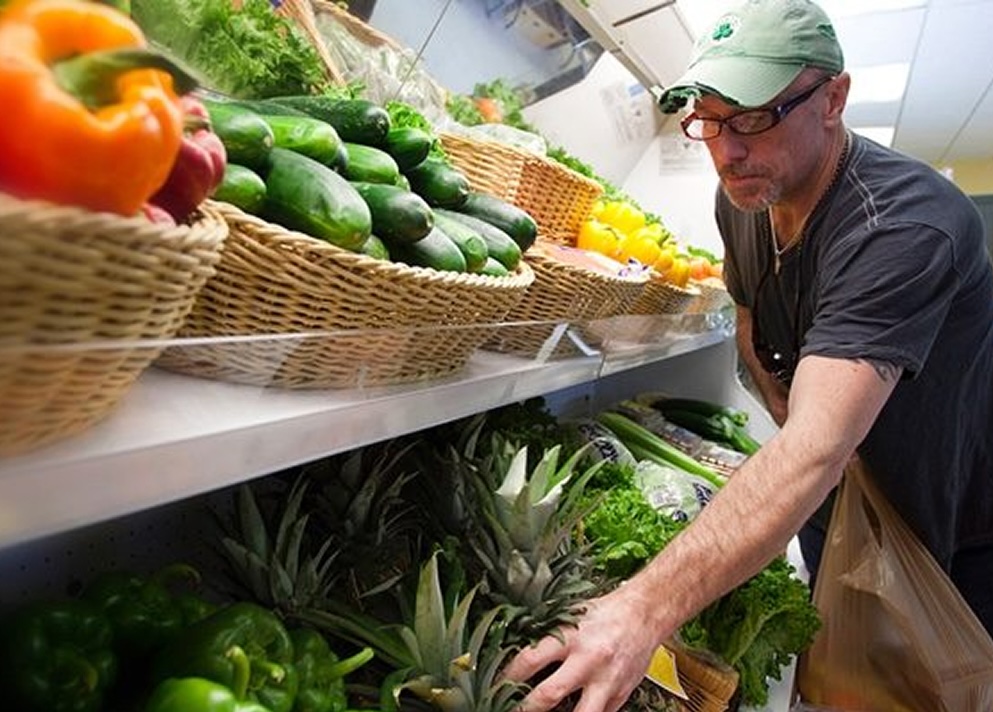
About 30% of GBFB’s distribution now consists of fresh produce, including peppers, mangoes, yucca, cabbage, and plantains, reflecting both nutritional goals and cultural relevance.
That shift, Dr. Fiechtner added, is essential. “Food brings us back to our childhood and our culture. If someone recognizes it, they are far more likely to eat it — and then the nutrition actually matters.”
Fresh produce is distributed through GBFB’s mobile markets, which source food through a network of farmers and suppliers and bring it to schools and community sites in high-need areas.
Addressing the Food Insecurity Cycle
According to GBFB research, food insecurity drives higher healthcare costs by increasing reliance on emergency care rather than preventive services. A statewide estimate places related hospital and emergency costs on MassHealth at roughly $1.6 billion.
Clinicians describe a cycle in which limited budgets force families toward cheaper, less nutritious food, contributing to chronic conditions and rising healthcare costs that deepen instability.
To address this, GBFB and Mass General Brigham have expanded mobile markets, hospital-based food pantries, and partnerships with community organizations such as La Colaborativa in Chelsea, a majority-Latino city where about two-thirds of residents identify as Hispanic or Latino.
The Greater Boston Food Bank organized its annual fundraising event, Taste of the Food Bank, on Thursday, May 14, at its South Bay Avenue warehouse, bringing together more than 400 community leaders, philanthropists, and chefs for the 2026 edition.
“Everyone deserves the opportunity to have a meal. What matters is being able to help, even in a small way, in a way that can make a difference. As a Latino chef, I feel a responsibility to give back and contribute in any way I can,” said Wilfredo Guerrero, chef at Saloniki Greek, during the event.

Chef Wilfredo Guerrero of Saloniki Greek was one of the restaurants at the 2026 Taste of the Food Bank, GBFB’s annual fundraiser. (Photo by Rosanna Marinelli/The Latino Newsletter)
In total, the event raised a record-breaking $1.17 million, the largest single-fundraiser total in GBFB history. According to D’Amato, the funds will support the purchase of food and help sustain the organization’s vast distribution network, which serves hundreds of thousands of people each year.
Rosanna Marinelli is a multimedia correspondent for The Latino Newsletter and the News Editor at El Planeta.
The Latino Newsletter is a 501(c)(3) nonprofit organization, and just turned 2! Help us with our birthday campaign by giving here.
And Now a Word From Our Sponsor
Sound familiar?

Over 4 million people have had the same lightbulb moment.
Morning Brew is a free daily newsletter that breaks down what's happening in business, finance, and tech — clearly, quickly, and with enough personality to make it the best email in your inbox.
No yelling. No filler. Just the news, finally making sense.
What We’re Watching
Our Copa, Episode 1: The first episode of Our Copa, which I co-host with former professional soccer player Merritt Mathias and award-winning author and soccer expert Musa Okwonga, is live. Let me know what you think! — JRV (email me here)
Julio Ricardo Varela edited and published this edition of The Latino Newsletter.
Consider donating to The Latino Newsletter. Any contribution, no matter how small, helps keep this newsletter free and accessible to all. ¡Gracias mil!