

Courtesy of MS NOW
Earlier on Tuesday, Puerto Rico Governor Jenniffer González-Colón appeared on MS NOW during the broadcast of “On the Line with Alicia Menendez.”
We wanted to share the initial transcript that MS NOW sent over to the media. This is a rush transcript, but it captures what González-Colón said, specifically about Puerto Rico’s water crisis.

ALICIA MENENDEZ, MS NOW HOST: Tens of thousands of U.S. citizens are struggling to get one of life’s most basic necessities, water.
In Puerto Rico, many residents haven’t had consistent water service for months, an issue brought on by severe drought and years-long infrastructure issues. The island is enforcing 48-hour water shutoffs and rationing for 180,000 households.
MS NOW’s Rosa Flores got a firsthand look at what residents are dealing with, like 71-year-old David Sánchez, who walks an hour to fill jugs with water, or cafe manager Juliana Macari, who says her business hasn’t had service for 137 days this year.
(BEGIN VIDEO CLIP)
JULIANA MACARI, MANAGER, CAFÉ REGINA: I mean, if 60 percent of the year without water doesn’t constitute a crisis and an emergency, I don’t know what does, honestly.
(END VIDEO CLIP)
MENENDEZ: Puerto Rico’s governor has declared a local state of emergency, and FEMA says it’s deployed 16 water tankers. But frustration is boiling over, as protesters hit the streets in San Juan Saturday, urging for more action to get them relief.
The governor of Puerto Rico, Jenniffer González-Colón, joins me now.
Governor, thank you so much for being with us.
You are an ally of the president. Have you personally communicated to the president that 180,000 households in Puerto Rico are without regular water service?
GOV. JENNIFFER GONZÁLEZ-COLÓN (R), PUERTO RICO: We are part of a situation. I mean, the — we declared an emergency on the 31st of July of this year.
And we’re working with the six federal agencies that are helping us this way, not just FEMA, the Department of Agriculture and six federal agencies that are actually deploying a lot of the help. We actually asked the U.S. Department of Agriculture to help us. That’s the agency that actually can help us.
We do have two states right now, Maryland and Virginia, that declared a drought emergency as well. So this is not unique to Puerto Rico. This has happened in the Midwest. This has happened around the world.
MENENDEZ: U.S. Virgin Islands.
GONZÁLEZ-COLÓN: Yes. And this is happening because of El Niño.
We do have problems with the rainfall. We don’t have rainfall at this time. So this is 13 percent of the island that is having the rationing situation. We are trying to expand the reservoir of Carraizo with serving seven towns as we speak, 183,000 people.
And that is plus a situation that we do have with the infrastructure in the San Juan metropolitan area, a program of more than $9 billion. Actually, the president helped us out in February of this year unlocking federal — almost $1 billion, federal taxpayers’ dollars to invest in that infrastructure on the island.
FEMA deployed the money, and we do have more than $2.5 billion of investment in construction as we speak.
MENENDEZ: Help me understand, though, why not ask for a formal federal major disaster declaration?
GONZÁLEZ-COLÓN: Right now, the Congressional Research Service has informed us that there’s no declaration, major declaration, approval in the states since 1980. No state has been granted a major declaration disaster for drought. So that’s the reality.
And, right now, the Stafford Act, which is the national emergency declaration, says that you need to exhaust all the local assets, all the local resources before asking for a national declaration of emergency.
MENENDEZ: So you, in essence, don’t believe that you have met the threshold.
GONZÁLEZ-COLÓN: Not yet. Not yet. And we are not ruling that out.
We need to exhaust all those resources. And, right now, the federal agencies are helping us out in that way. And we are right now using the local assets — assets. Again, we just approved the emergency declaration on the 31st of July. We’re using those resources.


We are not there yet. We are not ruling out that declaration of emergency. We’re asking the Department of Agriculture to rule a declaration of drought to the island. And we’re working with them. So, the federal agencies on the island, the six federal agencies that are working with us right now, are helping us directly.
MENENDEZ: Let me ask you about the infrastructure.
My colleague Rosa Flores was in Puerto Rico this week. She spoke with one woman who hasn’t had consistent water service in 14 months. Take a listen.
(BEGIN VIDEO CLIP)
ROSA FLORES, MS NOW NATIONAL REPORTER: She says that she wants to make one thing very clear — that the issue is not just the drought. She says the drought, yes, exacerbates the problem, but that she’s been without water for 14 months, and that precedes the drought.
(SPEAKING IN SPANISH) Who do you blame for this?
UNIDENTIFIED FEMALE: (SPEAKING IN SPANISH)
FLORES: She says she blames the governor.
(END VIDEO CLIP)
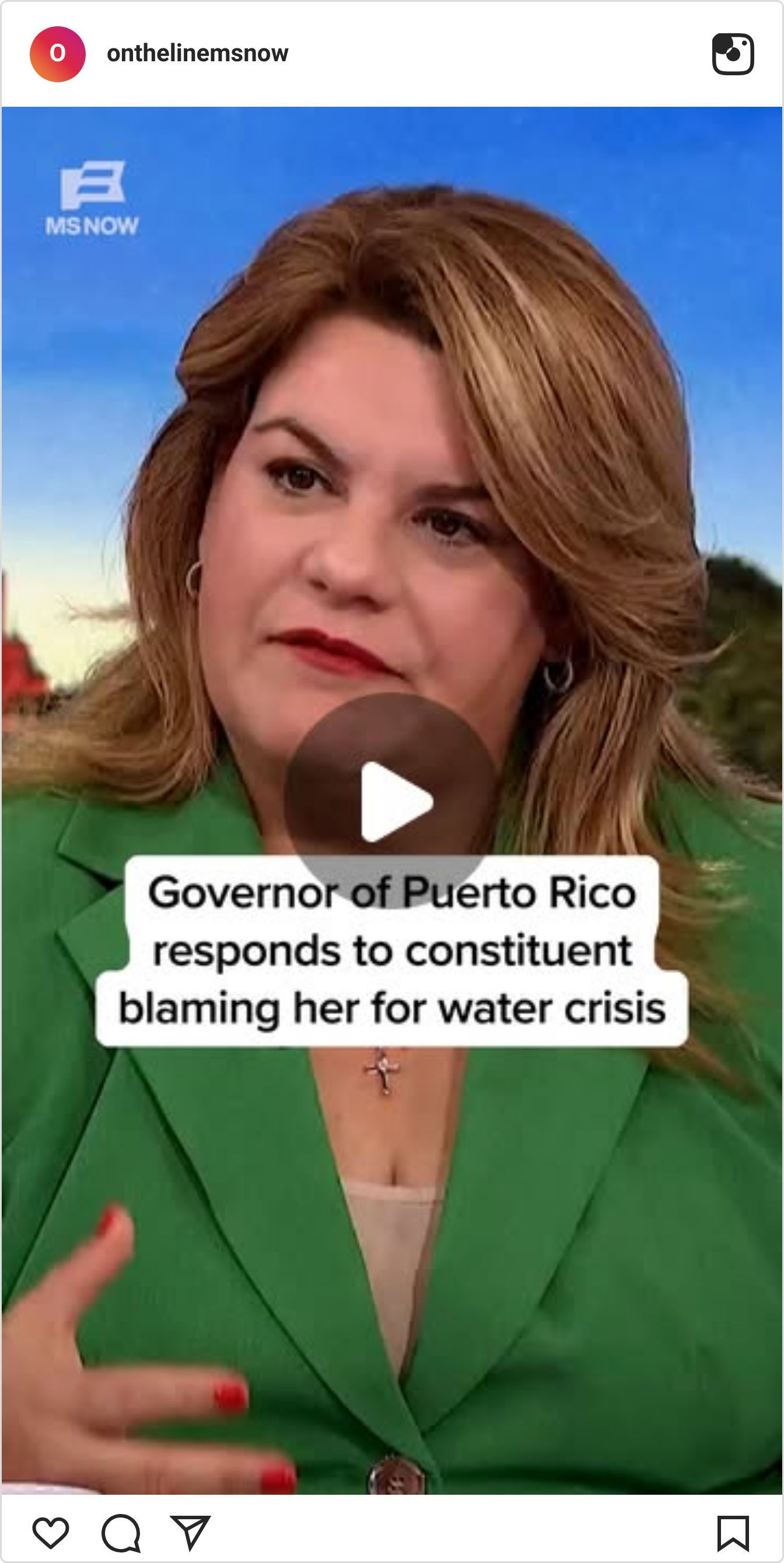
MENENDEZ: I’m going to give you a chance to respond to your constituent.
GONZÁLEZ-COLÓN: I totally understand the frustration.
When you get a system that was a monopoly of the government of Puerto Rico for more than 50 years, and there was a lack of maintenance and a lack of investment on that infrastructure that was a property of the government for 50 years, that will — that will happen.
And that was the reason when I was a member of Congress, after the Hurricanes Irma and Maria hit the island, we got a lot of federal money that was appointed to the island, but it was not disbursed. So that was the first thing I asked the president. And during February of this year, we received a lot of that fund.
And, right now, we have gotten $2.5 billion in construction for many of those projects that are — that are critical infrastructure for water and for electricity. And there is $9 billion between state funds and federal funds in design and capital projects for all water infrastructure, not just in the metropolitan area, the whole island.
So, this is the biggest investment in critical infrastructure for water on the island right now. So, those people in the metropolitan area that are having those issues with critical infrastructure, that’s true. And that — those are the main issues that we’re trying to solve as we speak and I inherited, because we’re not talking about this issue of one year.
There are common issues for many years before me. And...
(CROSSTALK)
MENENDEZ: Though your party has been in power for the past decade.
GONZÁLEZ-COLÓN: Yes. Yes. And there’s lack of maintenance for many, many years.
The state of that infrastructure, 40, 60 years of lack of maintenance and investment, is the main reason we are deploying a lot of construction, a lot of design, a lot of — and a lot of investment that has not been there for years. That’s the reason. Right now, you get a plan of investment that is happening as we speak, and not just in the metropolitan area. We’re talking about the whole island itself.
MENENDEZ: Let’s talk about investment.
GONZÁLEZ-COLÓN: Yes.
MENENDEZ: It’s part of why you are here in New York today.
GONZÁLEZ-COLÓN: Yes.
MENENDEZ: There is a plan to basically offer a tax incentive to high-net-worth individuals who may want to relocate to Puerto Rico in order to receive that tax incentive. You see it as a way of drawing investors to the island, as I understand it.
There’s been a version of this program in place since about 2012. It kicked into high gear in 2019. Why double down on it now?
GONZÁLEZ-COLÓN: I believe people are — many people don’t understand that Puerto Rico is part of the United States.
MENENDEZ: Indeed.
GONZÁLEZ-COLÓN: And that means that everything you make in Puerto Rico, it’s made in the United States.
And that’s a plus that many people are not even aware — 44 percent of the economy of the island is manufacturing, manufacturing in pharmaceutical, manufacturing in medical devices. So that means that 14 of the top 20 companies in pharmaceutical got a place on the island.
So that means that we export $5.8 billion in goods that are made in Puerto Rico. That’s a surplus. So, we ran on a $2.8 billion surplus. So this is the perfect time to invest in Puerto Rico. That tax reform, first phase of tax reform we just approved, that means that people can invest in the island.
We are — we are doing permitting reform. We are trying to expedite those people who are trying to invest and deploy their resources on the island. So, it —this is a time Puerto Rico is open for business. So, we — when we came up today to ring the bell, saying that Puerto Rico is open for business, and it’s not just of that sign, that historical moment.
Never before a governor of Puerto Rico had just came here not to — not to come to do a loan or sign a bonus. This is to say, come and invest in the island. There’s more employment in the private sector than ever before, higher construction than ever before, private sector jobs, cement.
And this is a time for economic development on the island, aerospace, pharmaceutical, medical devices. And the tax incentives and the 4 percent revenues and capital gains that we’re just working in the tax — in the tax reform, that we’re just sending to the legislature, I think it’s going to be one of the best reforms that are going to be available for people moving to the island.
MENENDEZ: Governor Jenniffer Gonzalez-Colon.
GONZÁLEZ-COLÓN: Thank you.
MENENDEZ: Governor, thank you so much.
The Latino Newsletter is an independent nonprofit journalism outlet and production company. Your support will get us to a second season of American Colony. Give now to support our work.