
In partnership with

.jpg)
The Puerto Rico Capitol building in San Juan, Puerto Rico (Source: Brad Clinesmith from Wilkes-Barre, PA, USA, CC BY-SA 2.0 via Wikimedia Commons)
Opinion for The Latino Newsletter
SAN JUAN — A few months ago, I wrote that Puerto Rico had become the new battleground for women’s reproductive rights. Over the past year, there have been several attacks to restrict a woman’s right to choose. Just a few months ago, pro-statehood Partido Nuevo Progresista Governor Jenniffer González-Colón signed a law that gives fetuses legal personhood and classifies the death of an unborn child at any stage of pregnancy as murder.
I described these changes as dystopian and warned that, although abortion remains legal in Puerto Rico, women’s lives are at risk as even stricter restrictions loom.
Sadly, I wasn’t wrong. What I didn’t anticipate was how antagonistic the battle would become.
The latest restrictive measure once again comes from Independent Senator Joanne Rodríguez Veve, an outspoken anti-abortion standard-bearer and a canon law expert. She recently asked the Puerto Rico Department of Justice to “immediately” launch a criminal investigation into the abortion clinics and their doctors, namely the only four operating on the island: Darlington Medical Associates, Women’s Medical Pavilion, Clínica Iella (ProFamilias), and Centro de Planificación Familiar.
Using a Health Department audit as ammunition, Rodríguez Veve alleged penal code violations and management irregularities, as well as a rise in abortion cases.
According to the audit, some patient files lacked a description of the disease or condition treated, or did not list a doctor for procedures, as required by Article 98 of the Puerto Rican Penal Code. That law states that abortion is legal if it's done to protect the patient’s life or health, including mental health.
The Puerto Rican Justice Department has said it would refer Rodríguez Veve’s request to the appropriate division. The clinics, under the umbrella of the Puerto Rican Coalition of Abortion Clinics, rejected her allegations of irregularities in their operations, insisting that the issues raised do not require criminal penalties.
Rodríguez Veve is directly targeting Darlington Medical Associates — the only clinic that performs abortions up to 24 weeks — and Dr. Yari Vale Moreno, the clinic's medical director and one of Puerto Rico’s most prominent reproductive rights advocates.
While Vale Moreno has always been positioned as Rodríguez Veve’s abortion antagonist, this new legal ploy has escalated the battle for abortion rights into a confrontation of rivals that mimics a fight between good and evil. Alongside the aforementioned claims, Rodríguez Veve alleged a “campaign” to attract out-of-state patients to Puerto Rico for abortions.
“Abortions at this clinic increased dramatically starting in 2022, after the repeal of Roe v. Wade. Between 2022 and 2024, the increase was 320.6%. This increase is linked to an advertising campaign run by the clinic itself to promote Puerto Rico as an easily accessible abortion destination for women from Florida, Texas, and Louisiana,” the senator claimed.
Abortions in Puerto Rico have increased steadily since Roe v. Wade was overturned, partly because out-of-state patients are traveling to the island for abortion care. In 2021, there were 4,225 abortions. By 2024, the number had risen to 5,704. This rise reflects that more women want and are able to access abortion, which is a right protected by law. Abortion is essential healthcare that empowers people to make decisions about their own bodies. I do not see the problem with this.
Previous Clash
Rodríguez Veve and Vale Moreno have clashed before. Their first confrontation was during public hearings on a bill to ban abortion after 22 weeks.
Vale Moreno’s testimony during the hearings — that she usually does not ask adult women the reason they’re getting an abortion — is now being used against her because the documents do not have a reason for treatment.“It reminds me a bit of Spain in the 90s, when next to every [abortion] clinic, a psychiatrist was certifying that the patients were crazy and shouldn’t be allowed to access abortion services. It’s ridiculous, but it’s obvious what [this new measure] intends to do.”
However, even in the middle of this legislative battle, abortion is still legal under local law.
That legal right was enshrined in the island’s constitution and protected by the right to privacy under Puerto Rico’s penal code. There are no gestational limits and no waiting times. No parental consent is required if a person is over 15. Previously, a person did not need parental consent if they were under 15, but a 2025 law sponsored by Rodríguez Veve changed that.
How It Changed
Modern abortion law in Puerto Rico was shaped by a landmark Supreme Court ruling in Pueblo v. Duarte (1980) that legalized abortion if it is necessary to protect a person’s physical or mental health, or their life. However, when Roe v. Wade was struck down, conservative Puerto Rican politicians and religious pro-life groups saw an opportunity. Emboldened by the ruling, they argued that the end of Roe implicitly negated the 1980 ruling. They rushed to adopt the U.S. anti-abortion lobby’s battle plan, using legislation as their battering ram.
“That [the end of Roe] changes the Puerto Rican political scenario concerning the abortion debate. People now know that no federal jurisprudence limits what we can and can’t do. That is to say, we have an open field,” Rodríguez Veve told me in 2023.

But she knows it would take a strong legal case challenging Pueblo v. Duarte for the right to an abortion in Puerto Rico to be eliminated.
Will this new escalation of Rodríguez Veve’s war against abortion succeed? We shall see. But no matter the result, it will not be the end of her campaign.
Recently, there was a March for Reproductive Justice in San Juan. Organizations that have fought for women’s reproductive rights on the island for decades took part. I applaud them, but we need more. We need a modern "Bastille" moment, like the Summer of 2019, when a nonviolent popular uprising involving nearly a third of the population successfully forced the resignation of then-Governor Ricardo Rosselló of the PNP.
As Vale Moreno said at the end of our conversation: “We need to take our rage to the streets.” Otherwise, people like Rodríguez Veve will prevail.
Yet the question I ask myself, time and again, is why more women, who make up 53% of the archipelago’s population, are not out on the streets of Puerto Rico protesting.
I haven’t yet found the answer.
A former News Director for Univision Puerto Rico and conflict correspondent, Susanne Ramírez de Arellano is a Columnist for The Latino Newsletter.
The Latino Newsletter is a 501(c)(3) nonprofit organization. Help us reach our goal to fund our podcast’s third season and to offer more opportunities for journalists to file their stories without paywalls or paid subscriptions.
And Now a Word From Our Sponsor
Protect online privacy from the very first click

Your digital footprint starts before you can even walk.
In today’s data economy, “free” inboxes from Google and Microsoft, like Gmail and Outlook, are funded by data collection. Emails can be analyzed to personalize ads, train algorithms, and build long-term behavioral profiles to sell to third-party data brokers.
From family updates, school registrations, medical reports, to financial service emails, social media accounts, job applications, a digital identity can take shape long before someone understands what privacy means.
Privacy shouldn’t begin when you’re old enough to manage your settings. It should be the default from the start.
Proton Mail takes a different approach: no ads, no tracking, no data profiling — just private communication by default. Because the next generation deserves technology that protects them, not profiles them.
What We’re Reading (and Watching Soon)
SCOTUS Narrows Voting Rights Act: From Intelligencer, the Supreme Court dealt a crushing blow to the Voting Rights Act as a tool to prevent the denial of minority representation in legislative bodies. The 6-3 decision in Louisiana v. Callais struck down a 2024 Louisiana congressional map that would have created a second majority-Black congressional district in the state. The decision could lead to a wholesale redrawing of congressional and state legislative maps as part of partisan gerrymandering, Intelligencer wrote.

Puerto Ricans Under Threat of Displacement: From the Juan Antonio Corretjer Puerto Rican Cultural Center, a community of Puerto Ricans is under the threat of displacement after an Illinois developer with a controversial tax decree bought land in Loíza to develop a gigantic luxury hotel and resort complex. Five years ago, when the land their houses were built on was sold, they had been assured they would be safe from displacement. Now, they are one of several communities under threat as the archipelago becomes a playground for luxury developers.
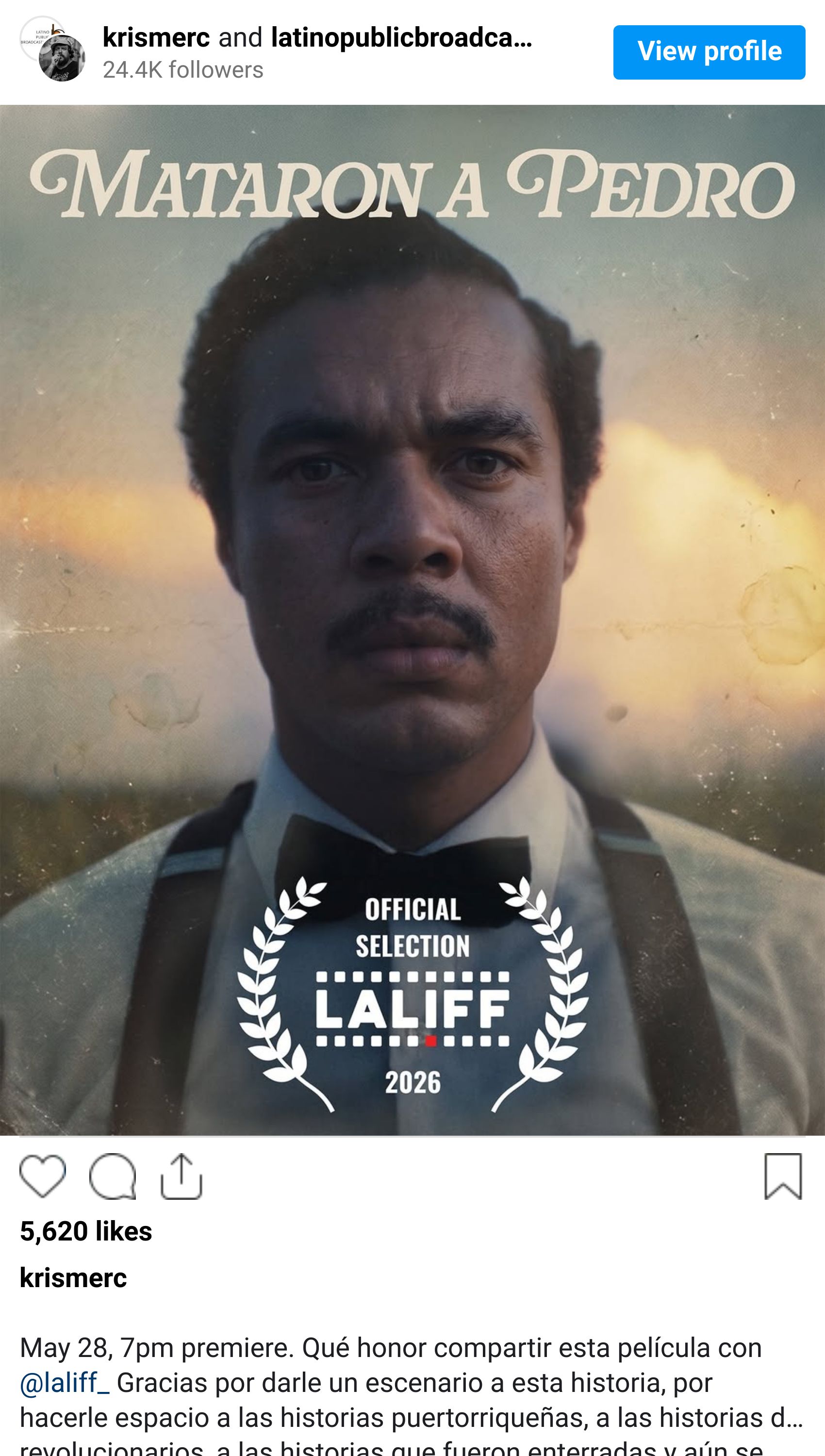
Puerto Rico on the Big Screen: The untold story of Pedro Albizu Campos, a hero of the Puerto Rican independence movement, will premiere at the Los Angeles Latino International Film Festival on May 28, according to a post by the director. The film follows Albizu Campos, a Black Harvard-trained lawyer, and his wife, Laura Meneses, when they return to Puerto Rico from the United States and face off against a white police chief and a white governor in support of striking farmers.
Carlos Berríos Polanco edited and published this edition of The Latino Newsletter.
The Latino Newsletter welcomes opinion pieces in English and/or Spanish from community voices. Submission guidelines are here. The views expressed by outside opinion contributors do not necessarily reflect the editorial views of this outlet or its employees.