

The Massachusetts State House (Photo by Julio Ricardo Varela/The Latino Newsletter)
Editor’s Note: Para la versión en español de este artículo, visita El Planeta.
It’s no surprise that Latinos now make up a growing share of Massachusetts’ population and economy, and their numbers continue to rise. Yet in 2025, many Latino families still can’t afford to buy homes in the state, and heightened fears around immigration enforcement — even among local businesses — are putting community stability and economic participation at risk.
Which brings us to ask: What is Governor Maura Healey actually doing to stand with the Latino community beyond policies? Last week, she sat down with The Latino Newsletter and El Planeta to share her view on the state of Latinos in Massachusetts.
The governor stressed that “Latinos are driving our economy, driving businesses,” noting that Latino-owned businesses have surged from about 49,000 to nearly 60,000 during her time in office — a 23% jump in just two years. Her comments echo findings from “¡Vamos Massachusetts!,” a report from We Are ALX and the Massachusetts Taxpayers Foundation that highlights Latino entrepreneurship as one of the state’s brightest economic spots and outlines what it will take to ensure opportunity grows alongside that momentum.

But behind those encouraging stats, there’s been a lot of uncertainty recently. Families are feeling it every day.
Stability and Economic Participation
Massachusetts residents are facing a challenging period. Part of that difficulty, Healey explained, comes from U.S. Immigration and Customs Enforcement (ICE) detaining people who have lived in these communities for many years — people who work, pay taxes, and raise families in the state.
Healey described a visit to Chelsea, sitting inside a small apartment with a mother, a grandmother, an aunt, and three children waiting by the window for their dad to come home from work.
“But he never came home. ICE had taken him,” she said, pausing as she recalled the moment, a 16-year-old daughter standing in the corner of the room, quietly crying.
The governor warns that stories like this are happening more often, with consequences now being felt across Massachusetts.
“It is heartbreaking and tragic to see people afraid to go to school, to the doctor, to work, or to shop,” the governor said. In Chelsea, for example, the city expects to lose roughly 300 students this year — a 5% drop — mostly from Latino and immigrant families who have left the state or are too afraid to send their children to school.

“This also hurts us economically because businesses have closed or people haven't been able to go to work, which means they can't pay the bills and they can't feed their families,” she added.
The Healey‑Driscoll administration has been teaming up with immigrant organizations to ensure families know their rights and can access legal help. At the same time, they’re stepping in to support U.S.-born kids whose parents have been detained, making sure they’re fed, in school, and safe.

El Planeta reporter Liza Martin Carfi (bottom right) asks Massachusetts Governor Maura Healey (center) a question at the Massachusetts State House, November 24, 2025 (Photo courtesy of the Governor’s Office)
Latino Contributions in the State
Through it all, Massachusetts is focused on keeping life more affordable while investing in people and the economy.
High school graduation and college enrollment among Latino students have been climbing steadily. Graduation gaps are shrinking, and more students are earning degrees. Building on that progress, Massachusetts is making community college more accessible with programs like MassReconnect and MassEducate. Enrollment is bouncing back after years of decline, adult enrollment is up nearly 45% in just a year, and more students are filling out the FAFSA, which means more financial aid and less debt down the road.
Yet gaps remain. Only 41% of Latino high school graduates go on to college, compared with 63% of all students. That gap costs the state $174 million in annual wages and over $3 billion in economic activity over five years.
Latinos are expected to make up six in 10 of Massachusetts’ new workers over the next five years, filling about 143,000 jobs in manufacturing, clean energy, and life sciences. To prepare, the state is building training pipelines: Life sciences students can join paid internships through programs like the Internship Challenge, while initiatives in advanced manufacturing and tech connect Hispanic workers with entry-level jobs and internships.
More Opportunities
“¡Vamos Massachusetts!” shows that homeownership is a key way to build wealth, but only 32% of Hispanic/Latino households in the state own a home, well below the national rate for Latinos and less than half the rate of white households in Massachusetts. Closing that gap could add $25 billion in assets for these families and boost the state’s economy.
Healey said she has made housing affordability a top priority in Massachusetts, dedicating $5 billion to increase the number of homes across the state. Her administration has rolled out programs like the One Plus Mortgage, which helps first-time homebuyers, and accessory dwelling units, alongside zoning and permitting reforms to make development easier. Highlighting the impact on diverse communities, she noted: “What’s interesting to me is that 52% of those who participated in the One Plus Mortgage program are Latino.”
State House data shows that tax credit incentives for developers have driven substantial housing growth in Massachusetts’ gateway cities, including Revere, where availability has skyrocketed in some areas.
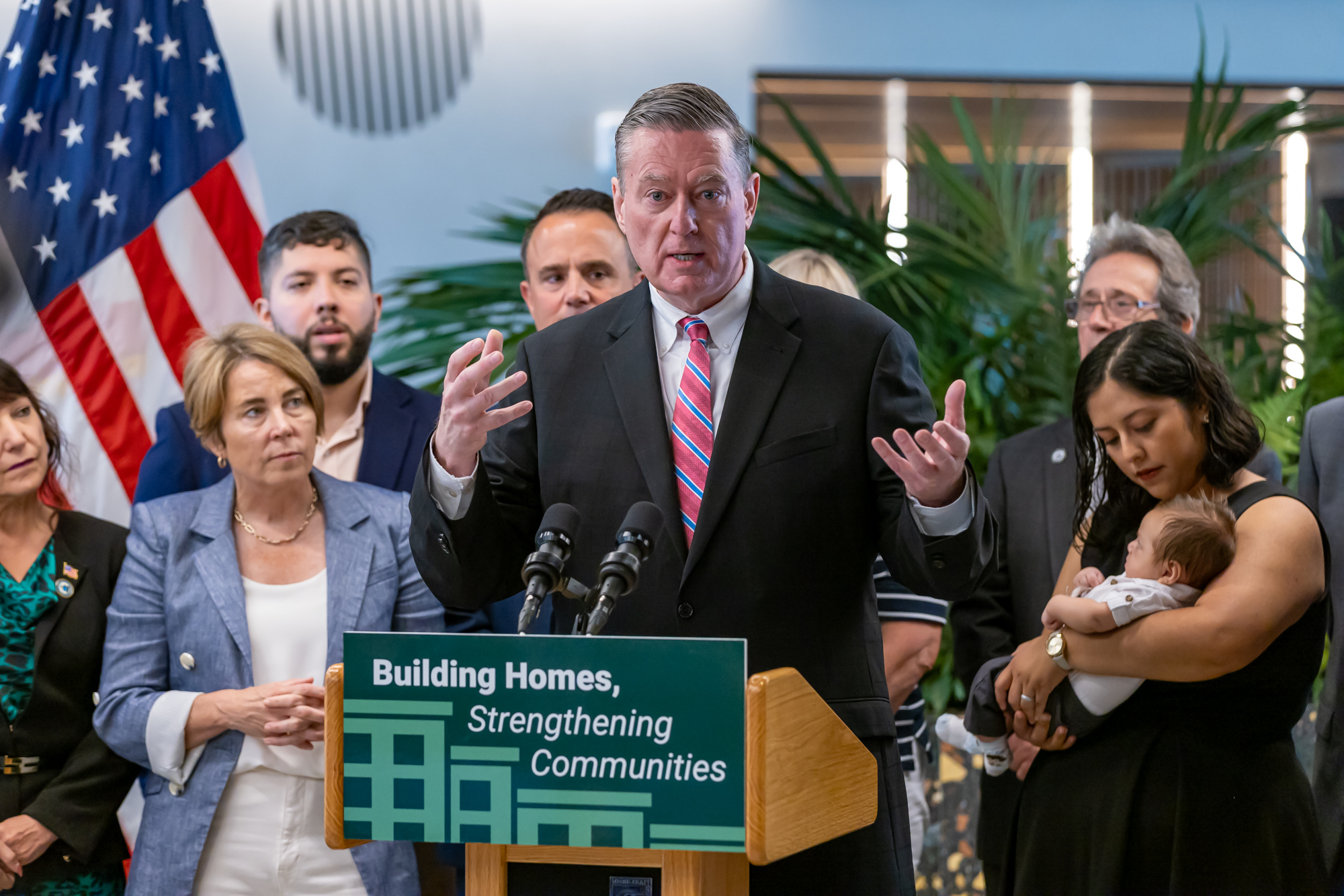
Since taking office, Healey noted she has focused on both new construction and creative reuse of existing structures, converting abandoned buildings, old office space, and unused mills into housing. Public housing investments have brought 65,000 units back online, while renter protections, like eliminating broker fees, make housing more accessible.
The governor stressed that the work is far from over, adding that “President Trump needs to get rid of the tariffs on lumber and building supplies, because they drive up costs and make housing production more expensive around this country.”
The World Cup and 2026
Massachusetts is preparing for the 2026 World Cup, and the governor sees it as a unique opportunity for communities across the state. “Soccer brings people together,” Healey said. “No matter which teams come, Massachusetts will host a big celebration with activities in communities around the state.”
Healey said the World Cup is a chance to highlight the state’s cultural diversity, particularly in the Latino community, while also boosting the local economy. Fans traveling to the games will support restaurants, hotels, and small businesses, creating an influx of activity across New England.
At the same time, safety is a key focus for Massachusetts. “We want to make sure that people have an excellent and safe experience. That’s why multiple agencies have been coordinating, meeting regularly, and communicating with the FIFA organizers. We’re mapping everything out to ensure the right resources are in place so these games go off without a hitch,” the governor added.
Looking ahead to 2026, a year when she will run for re-election, Healey said her eyes are on the state’s growing Latino residents. She said that she is focused on tackling affordability, building more housing, lowering energy and healthcare costs, and investing in jobs and education.
Rosanna Marinelli is a multimedia correspondent for The Latino Newsletter and the News Editor at El Planeta.
Help us reach our $50,000 goal by December 31 to power next year’s reporting, community storytelling, and a new audio documentary on Puerto Rico.
What We’re Reading
U.S. Halts Immigration Cases: From Camilo Montoya-Galvez of CBS News, “The Trump administration has halted all immigration applications filed by people from 19 countries, its latest move to restrict legal immigration pathways following the shooting of two National Guard members in Washington, D.C., last week, according to internal government guidance and a source familiar with the move.”
Consider donating to The Latino Newsletter. Any contribution, no matter how small, helps keep this newsletter free and accessible to all. ¡Gracias mil!