
In partnership with


Via Canva Pro (By Strelov)
The United States launched a large-scale military operation in Venezuela on January 3, capturing President Nicolás Maduro and seizing control of the country’s strategic resources in what many Latin American governments branded a blatant violation of sovereignty and international law.
Violations of international law are not inconsequential. They shape civilian life and democratic norms, and, regardless of who carries them out, must be excoriated. But rejecting U.S. imperialism cannot mean excusing authoritarianism elsewhere.
United Nations fact-finding reports and Amnesty International have documented years of repression in Venezuela, including the violent suppression of protests, arbitrary arrests of political opponents, journalists, and human rights defenders, allegations of torture, and possible extrajudicial killings — carried out with near-total impunity. Treating these abuses as secondary — or worse, normal — in the name of anti-imperialism reflects a dangerous slide into illiberalism. And illiberalism does not cease to be illiberal when it speaks the language of the left.
On a livestream, political commentator Hasan Piker referred to Venezuelans who support Trump’s actions as “cumrags.” The remark was delivered far from the realities of most Venezuelans’ lives under economic sanctions, political repression, and pervasive fear — conditions that shape families like mine, who avoid speaking out because arbitrary arrests are a real risk. The episode raises an uncomfortable question: when suffering becomes an ideological premise, does irony function as critique, or as permission?
A similar pattern appears in online explanations of Venezuela offered by influencers like Django Buenz (@dj8ngo), who has framed the Venezuelan crisis through a nostalgic reverence for former President Hugo Chávez. She often cites his 2006 United Nations speech — when he said the podium “smelled like sulfur” after President George W. Bush spoke — as a formative moment of radicalization. These narratives create a substitute symbolism for material analysis, celebrating anti-imperialist spectacle, while sidelining the realities of repression and state power.
A Broader Weakness
These simplifications reflect a broader weakness in parts of Western leftist discourse: an emphasis on ideological purity that erases historical and material context — a tension explored in the book Empire by Michael Hardt and Antonio Negri.

When analysis begins with abstract ideals instead of lived reality, it risks misreading political struggle and inadvertently mirroring arguments used to justify external pressure or intervention. In Venezuela, this has meant flattening Venezuelans' lived experience — of sanctions, repression, and fear — with simplified narratives that gesture toward solidarity without grappling with reality.
Spain’s progressive Prime Minister Pedro Sánchez, Colombia’s President Gustavo Petro, along with leaders across Latin America, rightly issued a joint statement on January 4 condemning the U.S. strike as a violation of international law and a dangerous precedent for regional stability. Their insistence on sovereignty, non-intervention, and peaceful resolution reflects principles the left has long claimed to defend. But those principles cannot stop in opposition to foreign military action.
Yet sovereignty cannot be reduced to legal formalism itself. A commitment to human dignity and democratic resolution also requires confronting the Venezuelan government’s own record of repression. Dialogue cannot be meaningful while political prisoners remain behind bars, journalists face intimidation, and dissent is met with force. When appeals to non-intervention are used to shield governments from scrutiny while remaining silent on internal abuses, sovereignty risks becoming an argument emptied of any moral substance.
Sidelining Human Rights
The left and the right appear to have found rare common ground: a willingness to sideline human rights violations in service of ideological agendas.
But this convergence is not accidental. It is shaped by material incentives that encourage silence when accountability threatens economic or geopolitical interests. In Venezuela, those incentives are plainly visible.
Venezuela sits atop the world’s largest proven oil reserves, with roughly 300 billion barrels that could be tapped if infrastructure and investment were restored. Following the capture of Nicolás Maduro, the Trump administration has openly courted U.S. energy companies to rebuild and profit from that sector, even as firms caution that production is low and risky. When geopolitical or economic goals — whether control of oil or the avoidance of inconvenient truths — take precedence over human rights, rights cease to be foundational.

This is the logic of illiberalism: principles invoked selectively, law reduced to a tool of power.
If the left responds to the right by adopting the same selective moral logic, it will always lose. The right ignores violations of international law in Palestine when it is convenient. Much of the international left ignores human rights violations in Venezuela when they complicate anti-imperialist narratives.
The result is convergence, not opposition.
Ask any Venezuelan for whom leaving the country was less of an ideological decision than a last option. Ask someone for whom walking through the Darién Gap with a child was easier than staying and starving.
Yuleidy Peña was 20 years old when she left Venezuela on April 19, 2019. “I spent two years working in a restaurant with my husband and sending money to Venezuela,” she told Doctors Without Borders in 2022. She went on to tell the NGO that she had a baby. “Unfortunately, the situation became complicated because they no longer wanted Venezuelans — they wouldn't rent to us, they wouldn't let us work — so we decided to cross to Panama and try to get to the U.S.” Peña and her husband crossed the Darién Gap on foot because they did not have $800 for a boat, according to Doctors Without Borders.
At the end of April 2022, Hernán Betancourt, 27, and Mariana Tablante, 21, left the Venezuelan city of Miranda after saving $87 for the journey, a lot, considering the monthly minimum wage in Venezuela is 130 bolivars, or 40 cents, according to PBS, citing International Monetary Fund estimates.
“I couldn't go on living there,” Betancourt said. “My mother needed insulin, and she didn't have any. We were going to bed hungry, and we have a 1-year-old baby — we couldn't carry on like that. We felt suffocated, really suffocated.”
After all this, I ask Hasan Piker — and anyone else willing to humiliate human lives for rhetorical purity — whether these Venezuelans are also “cumrags” to imperialism and intervention.
If the left cannot look squarely at this suffering without subordinating it to narrative convenience, then it has already conceded the values it claims to uphold.
Henders Aponte is a high school student passionate about politics and journalism. He writes about culture, politics, immigration, and education. He is also of Venezuelan descent.
The Latino Newsletter is a 501(c)(3) nonprofit organization. Help us reach our $50,000 goal to fund our podcast’s third season and to offer more opportunities for journalists to file their stories without paywalls or paid subscriptions.
And Now a Word From Our Sponsor
Easy setup, easy money

Making money from your content shouldn’t be complicated. With Google AdSense, it isn’t.
Automatic ad placement and optimization ensure the highest-paying, most relevant ads appear on your site. And it literally takes just seconds to set up.
That’s why WikiHow, the world’s most popular how-to site, keeps it simple with Google AdSense: “All you do is drop a little code on your website and Google AdSense immediately starts working.”
The TL;DR? You focus on creating. Google AdSense handles the rest.
Start earning the easy way with AdSense.
What We’re Reading
Civil Rights Groups Demand Congressional Oversight: Ahead of Martin Luther King Jr. Day, a coalition of national civil rights, faith, and Latino advocacy organizations led by UnidosUS — the nation’s largest Hispanic civil rights and advocacy organization — held a virtual press conference calling on Congress to curb escalating abuses tied to federal immigration enforcement. The coalition, which includes the NAACP, LULAC, Voto Latino, and the National Urban League, marked one year of the Trump administration by citing the killing of U.S. citizen Renee Nicole Good in Minneapolis and mounting reports of racial profiling, unlawful detentions, and due process violations.
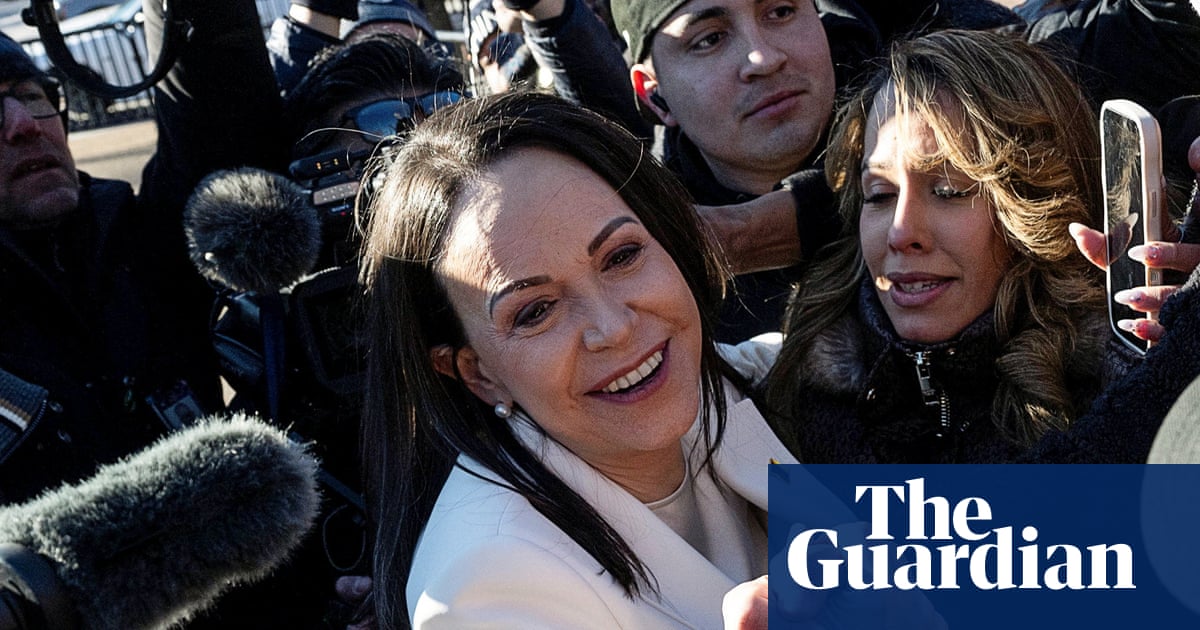
Machado and Trump: From the Guardian, “The Venezuelan opposition leader María Corina Machado has said she ‘presented’ her gold Nobel peace prize medal to Donald Trump after meeting him in the White House, nearly a fortnight after he ordered the abduction of Venezuela’s president, Nicolás Maduro.”
Serena Maria Daniels edited and published this edition of The Latino Newsletter.
The Latino Newsletter welcomes opinion pieces in English and/or Spanish from community voices. Submission guidelines are here. The views expressed by outside opinion contributors do not necessarily reflect the editorial views of this outlet or its employees.