

Screen grab of the Bad Bunny Super Bowl LX Halftime Show (Fair Use for review purposes)
Quick, hot, sizzlin’ takes have been dropping on Bad Bunny’s Super Bowl LX’s Halftime Show even before he performed the thing. I’m enjoying the Easter eggs, the memes, and the reactions in the cross-continental family chat. But there was a powerful choice in the opening sequence that set the tone for his “No fear” message, which really struck me as both relevant and poignant.
Once again, Bad Bunny exercised the radical idea of being unapologetic. He performed for us, Puerto Ricans, and by extension, Latinos everywhere. As colonial subjects, as “minorities,” in the U.S. and on the geopolitical stage, this is indeed radically opposed to the assimilation we’ve had to endure and the (ahem) ass-kissing our politicians and institutions have performed for centuries to the so-called Global North.
Benito Antonio Martínez Ocasio did not try to please 135 million global viewers or make his spectacle palatable or even understood by an Anglo public. Just like his Grammy-winning album, just like his Puerto Rico residency, just like his género urbano-defying career since the beginning, really, he continues to be himself — as imperfect as any human is — with his accented and broken English, not-that-great live vocals, and in the way he flaunts bellaqueo joy and calls out social injustices in equal measure.
No Explanations Needed
For the average American and the uninformed, this Super Bowl performance could pass as average. It wasn’t bombastic. There were no air acrobatics. His dancers didn’t have to march in Young Lords costumes to make this political. The machetes during the opening shots of his halftime show were not a symbol of liberation or rebellion, but, rather, a reminder of a painful past, of forced Black labor and economic collapse at the hands of autocratic measures that have forced mass migration and displacement of Puerto Ricans for decades. A fundamental part of our history, laid bare on the world’s biggest entertainment stage.
During Bad Bunny’s 31-date residency in Puerto Rico last summer, the set design was dominated by the now-famous casita (which, of course, I swear looks exactly like my abuelitos’ house in Villa Nevarez) and a towering, green, lush mountain presiding over el Choliseo.
The mountains, the home of the idealized (and whitewashed) noble jíbaro, where the air is pure, the land is fertile, and intellectuals strategized in secret, the Grito de Lares failed revolt of 1868.
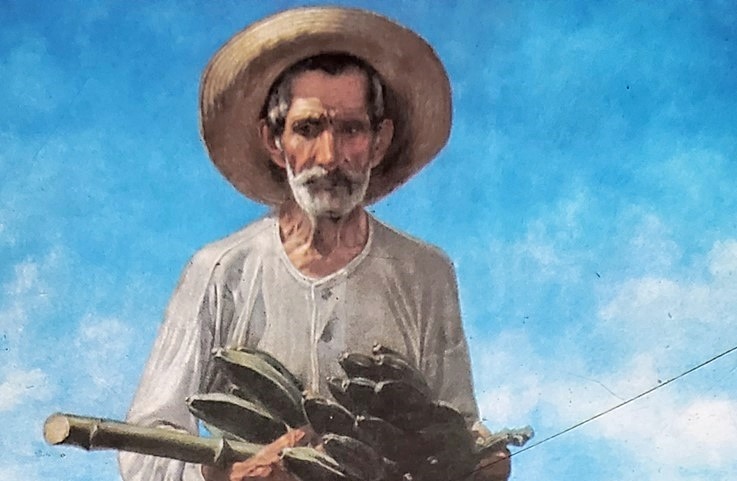
Bad Bunny himself has continued to romanticize jíbaros during his DTMF era by wearing the pava straw, which is heavily symbolic (co-opted by politicians and depicted in art for decades) — a fashion piece now made in China and worn by millions of unknowing fans worldwide (this is just wild).

During his Super Bowl performance, however, Benito Martínez didn’t bring el Yunque to Levi’s Stadium. Instead, he brought el cañaveral, the sugarcane plantations from the flat coastal areas of the island that caused so much strife and suffering to our people.
Under Spanish rule, enslaved Africans were brought to the island to grow and cut sugarcane, among other hard labor. They were exploited under brutal conditions, especially after the Haitian Revolution disrupted the sugar commerce in the Americas, and Spain wanted to profit. In these sun-drenched coastal communities surrounding the plantations, Black workers took respite from their enslavement through laments, song, and percussion. The bomba genre was born.
Among the sugar canes, escaped cimarrones hid from their oppressors. And when the United States took over Puerto Rico, American corporations deprioritized coffee and vegetable crops to focus even more on sugar production with underpaid, uneducated workers who were not slaves on paper but were still exploited and operating in poor conditions. And when that industry collapsed in the 1930s, the federal and local governments incentivized rural Puerto Ricans to migrate to New York, New England, and the Midwest to work in factories. That is what Benito is paying homage to in the sugar cane maze. (If there’s anything I would’ve liked to see in this section of the 13-minute set, it’s more Afroboricua representation in the cast and musicians hitting those bomba barriles very loudly so everyone can hear them.)
Another America
But the sugarcane maze also becomes relevant in Trump’s America. California, especially, where 75 percent of farmworkers are undocumented immigrants, is the state with the largest percentage of migrant workers working the land. Period. It has also been the focus of intense ICE raids in the past year, with many living in fear of deportation. Our farmhands across the nation feed all Americans, yet they say they want to eradicate us. Is that a strawberry picker flashing by behind Benito and the sugarcanes? It’s not by chance.
“Qué rico es ser latino,” says the jíbaro in the opening shot, smiling. Because pese a todo, seguimo’ aquí and we revel in self-worth. Through the sugarcane time tunnel, we see how the machete-holding laborers become present-day Latinos both at home and in the diaspora, building businesses such as piragua and taco stands, our elders playing dominoes, and couples falling in love. Also: women enjoying themselves, perreando solas, without fear, in our sexual prowess. Sobeteo y reggaeton pa’ tol mundo, no matter what we’ve been told till this day by authorities and the supposedly “elite,” that this music is garbage, that our local traditions are not enough because they are measured against foreign standards. “Baila sin miedo, ama sin miedo”, says Benito, joined by LGBTQ icons Lady Gaga and Ricky Martin.
When Bad Bunny falls inside the casita and interrupts a family watching the Super Bowl, I couldn’t help but draw parallels between real Latino parents and children afraid of leaving their homes because of fears of ICE raids. Back in the sugarcane corridor, the smiling female musicians of Mariachi Divas are now forming a spirit tunnel, playing the violins to the melody of “Monaco.” In passing, a Mexican flag peeks out of the field. Is that an immigrant hiding in the field, but defiant?

Screen grab of the Bad Bunny Super Bowl LX Halftime Show (Fair Use for review purposes)
Are they now a little bit less afraid, with a little bit more hope, surrounded by community? We saw this past week how neighbors and residents of Santa Clara, where the Super Bowl took place, mobilized to protest ICE and prepare for possible raids.
“Cuidao con mi corillo que somos un montón,” Bad Bunny says in “El Apagón.” The grand finale, out of the maze, and out of the stadium field and security cordon. The fourth wall falls down. Benito’s brother Bernie, producers, and members of his team appear on screen in civilian clothes to embrace their friend, dance, and jump with joy together, ending in collective chaos, but above all, community.
Nuria Net is the founder and CEO of Shake It Easy Media, a content studio that connects brands with the vastly diverse Latine audience through relevant and authentic storytelling. She is also one of The Latino Newsletter's Deputy Editors on a fractional basis and co-founder of Remezcla.
The Latino Newsletter is a 501(c)(3) nonprofit organization. Help us reach our $50,000 goal to fund our podcast’s third season and to offer more opportunities for journalists to file their stories without paywalls or paid subscriptions.
What We’re Watching (and Reading)
New Podcast Episode: The video version of our latest podcast episode is out. Filmmaker Colette Ghunim discusses her award-winning documentary “Traces of Home.” The film follows Colette and her parents as they return to Mexico and Palestine — the homelands they were forced to leave — to confront intergenerational trauma, displacement, and explore her cultural identity.
The Latino Newsletter on GBH: In case you missed it, I was repping The Latino Newsletter on Boston’s GBH this past weekend — JRV.
Julio Ricardo Varela edited and published this edition of The Latino Newsletter.
The Latino Newsletter welcomes opinion pieces in English and/or Spanish from community voices. Submission guidelines are here. The views expressed by outside opinion contributors do not necessarily reflect the editorial views of this outlet or its employees.