

Antoni Avanti, an East Boston resident entering East Boston High School to vote for Republican Mike Minogue. November 3, 2026. (Photo by Rosanna Marinelli / The Latino Newsletter)
Editor’s Note: Para la versión en español de este artículo, visita El Planeta.
Ana has lived in East Boston for 22 years and owns Ana’s Beauty Salon, a small business in the neighborhood. On Tuesday, she voted at East Boston High School and noticed she was far from alone. Many people were voting, she said.
“My expectations are very high, because there are many of us Latinos and our vote counts so much,” she told The Latino Newsletter before the results came in.
Outside that polling place, voters brought different concerns to the ballot: a salon owner worried about the economy, a community leader defending immigrant workers, a Colombian neighbor calling for a change in leadership, and two students concerned that many voters didn’t know what was on the ballot. All of them took part in a historic election.
Nationally, Democrats won control of both the House and the Senate, the first time since 2006 that a president’s party lost both chambers. Latinos, about 16% of the nation’s eligible voters, drove that shift. Hispanic voters were less likely to back Republican candidates than in the 2024 presidential election, according to the AP Voter Poll.
In Massachusetts, Latinos made up about 6% of voters on Tuesday, according to the NBC News exit poll. Still, the state added to the Democratic wave: Gov. Maura Healey won a second term, Sen. Ed Markey won a third, and all nine of the state’s U.S. House seats stayed Democratic.
A Second Term
With about 76% of the vote counted, Healey had 1,283,081 votes, or 62.5%. Republican Mike Minogue had 698,889 votes (34.1%), and independent Andrea James had 69,906 (3.4%). The Associated Press projected her win one minute after polls closed.
For Erica Sánchez, a community leader who works closely with East Boston organizations, that was the result she had worked for. She spent the weeks before the election urging Latinos to vote for Healey.
“Things need to improve, and with the president we have, who isn’t working out, plus another governor who would fully support him, we’d be worse off,” Sánchez said.
Latino turnout has room to grow. A record 258,000 Latinos voted in Massachusetts in 2024, according to UMass Boston’s Gastón Institute, but that was only 49.6% of those eligible. Among Hispanic voters surveyed before this election, about 73% planned to vote for Healey and 20% for Minogue, according to a Suffolk University/Boston Globe poll.
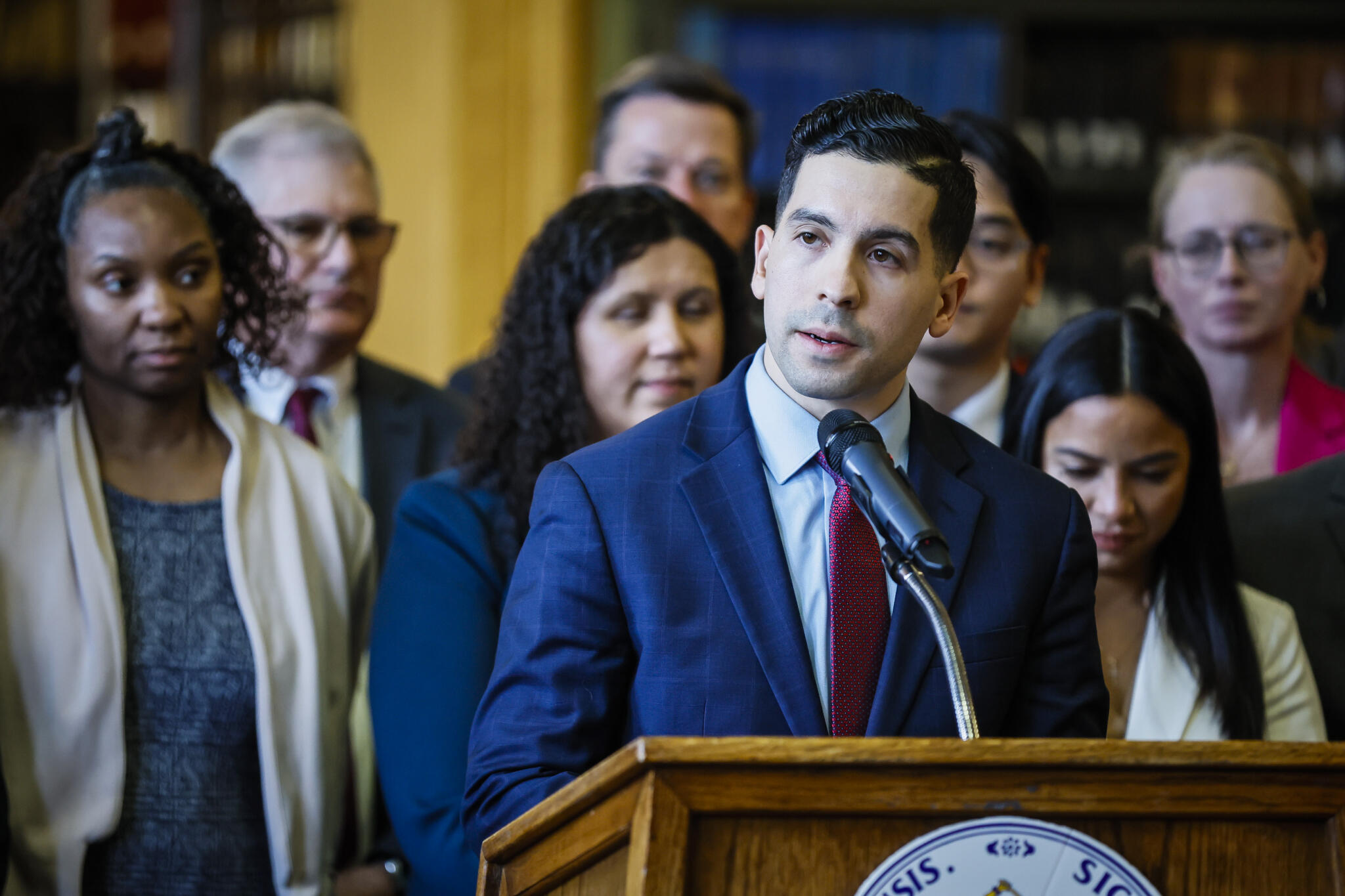
At the same polling place, Antoni Avanti was part of that minority. The Colombian neighbor, who works for a local school, voted for Minogue. His main complaint is that Healey has been absent from East Boston.
“There are a lot of crimes that never make it to the police station,” Avanti said. Unless a neighbor or the person who got hurt speaks up, he said, police don’t learn the details of what happened.
He said he no longer shares what he sees with Boston police or the State Police. “They’re kept on such a tight leash by the governor and the mayor,” he said.
Official numbers point the other way. Boston recorded 10 homicides in the first half of 2026, down from 21 a year earlier. But those figures count only crimes that reach police, and that gap worries Avanti.
The same concern shapes his view on immigration. He sides with Minogue, who has called for local police to work with federal agents, and supports deporting people with violent criminal records. He said authorities ignore federal requests to hold them. “They leave the paperwork there. They don’t call ICE about bad people,” he said.
Avanti said many Latinos reject Republicans because they assume it means supporting Trump. “You vote for the person, the candidate. You don’t vote for the party,” he said.
Latinos This Election
Several Massachusetts Latino lawmakers kept their seats on Tuesday without opposition. They include State Rep. Andy Vargas, chair of the Black and Latino Legislative Caucus, Sen. Pavel Payano of Lawrence, the first Dominican elected to the state Senate, and Reps. Frank Moran, Estela Reyes, Manny Cruz, Judith García and Sam Montaño.
Two Latinas are headed to the State House for the first time. Celina Reyes will represent Lawrence and Methuen after defeating Rep. Francisco Paulino in the September primary, and Lisa Lopez won an open seat in Canton.
They are part of a growing group. More than 100 Latinos now hold elected office in Massachusetts, out of roughly 7,500 elected positions statewide, according to a review of all 351 cities and towns by Unidos in Power, an organization that tracks Latino representation. In 1980, there was one.
What Voters Decided
Sebastian Cortet, 20, and Jamie Whalen spent Election Day asking voters about the nine ballot questions for a school project, first downtown and around Boston Common, then outside East Boston High School.
“I think this is a really strange election because I feel like a lot of people don’t know what’s going on,” Cortet said.
They focused on Question 1, which extends the public records law to the governor’s office and the Legislature. In about 15 minutes, three or four people told them they didn’t know about it.
“I think most people would probably vote yes on a question like that, because who doesn’t want the government to be public?” Cortet said. “But they don’t really understand its benefit. And I think that’s the problem.”
He was right about the vote. Question 1 passed with 86.1%, the widest margin of any ballot question. It is set to take effect in January 2027, but a separate bill in a legislative conference committee could supersede it.
Cortet’s family leans Democratic, he said, but “you don’t want to look at just red or blue.” Latino voters in East Boston, he added, “have different issues,” and their focus is elsewhere.
Nationally, young voters moved even more sharply than Latinos. About 7 in 10 voters under 30 backed Democratic House candidates, according to the AP Voter Poll.
In all the conversations with East Boston Latino voters, one message came through: do the homework, and don’t let a party decide for you.
Avanti said he spends hours at night and in the morning following the news. “I like to compare what you see in the newspapers with what you see on social media,” he said. “The more you educate yourself, the better decisions you can make.”
“Within our own community, some people think one thing and others think another, and you get confused,” Ana said. “But the main thing is to have your own judgment.”
Ana admitted she has sometimes hesitated to vote. But she said she understands why it matters.
“Whoever can vote is a small grain for big things in the future,” she said.
Rosanna Marinelli is a multimedia correspondent for The Latino Newsletter and the News Editor at El Planeta.
Your Donation Is Matched Until December 31
From now until December 31, your one-time gift to The Latino Newsletter will be doubled, and your new monthly gift will be matched 12 times, up to $1,000, while match funds last. Our stretch goal is to raise $40,000 by year’s end. Give now to keep us available to all.
What We’re Reading
Latinos and Democrats: While it’s clear that Latinos played a big role in Democrats’ midterm success this cycle, Democratic consultant Chuck Rocha filed a must-read opinion piece in the New York Times about how Latinos are “the indispensable swing bloc in our body politic.”

Rocha’s sentiments are similar to those of Massey Villarreal, national co-chair of the Comité de 100, a coalition of Mexican American and Latino business leaders that advocates for bipartisan immigration reform. Villarreal is a lifelong Republican who previously chaired the Republican National Hispanic Assembly and served as national vice chairman of the Bush-Cheney campaign.
In a conversation with The Latino Newsletter this week about the midterms, Villarreal noted that “the message to Democrats is that the Latino community is temperamental. If you’re not going to do things, and we brought you up there, and you don’t make any substantial changes on issues like immigration or affordability, it’ll be a flash in the pan. It’ll be great for right now, but by 2028, that flash will be gone, and there won’t be a vote.”
“Democrats are going to lose the opportunity, so they need to step into it, work across the aisle with willing Republicans, and pass meaningful immigration reform, workforce initiatives, and education reform,” Villarreal noted.
Consider donating to The Latino Newsletter. Any contribution, no matter how small, helps keep this newsletter free and accessible to all. ¡Gracias mil!
