

Activists carry a giant papier-mâché Puerto Rican nightjar (guabairo) through Old San Juan, Puerto Rico, March 28, 2026. (Photo by Carlos Berríos Polanco/The Latino Newsletter)
Opinion for The Latino Newsletter
On Saturday, March 28, thousands of people and over 70 organizations marched in San Juan, chanting, “Puerto Rico isn’t for sale, Puerto Rico defends itself.”
They carried a colossal Puerto Rican flag and a giant papier‑mâché sculpture of the endangered Puerto Rican nightjar (guabairo), which has become emblematic of the ongoing struggle to protect Cabo Rojo from Esencia, a luxury megaproject that would turn a stretch of public coast in the small, southwest village of Boquerón into a private enclave for the very rich.
People dancing and playing drums marched from Escambrón Beach to the Capitolio and then to La Fortaleza, the governor’s mansion, with a clear purpose — to stop Esencia from ever being built.
Finance Colonialism
Esencia is a real-time case study of finance colonialism. It’s a process where contemporary financial capital — operating through deliberately opaque instruments, such as private equity, vulture funds, and shell companies — uses colonial legal and bureaucratic architecture to turn public spaces and essential services into profitable assets for investors with no roots in the place, extracting value while leaving deep socio-ecological and economic damage behind.
In Puerto Rico, that architecture includes PROMESA, an unelected fiscal control board, and a complicit local government that has built not only a generous tax-incentive regime but a seemingly frictionless permitting apparatus, both enabled by colonial status rather than sovereign choice. The proposed Esencia project threatens Cabo Rojo’s ecosystems, people, and the very basics of daily life.
I have known Boquerón — its people and its beaches — all my life. As a child playing on the shore, as a teenager eating mangrove oysters and watching sunsets over the bay with my friends, as a pregnant woman buying snapper from artisanal fishers, as a mother teaching my children to swim, and as a grandmother watching birds in the local sanctuary with my first pair of binoculars. That same shore, those same mangroves, the fishers’ livelihoods, and the endangered species in the sanctuary are part of what would be at risk for the next generation if Esencia were built.

Activists carry a giant Puerto Rican flag through Old San Juan, Puerto Rico, March 28, 2026. (Photo by Carlos Berríos Polanco/The Latino Newsletter)
Increasingly, public beaches across Puerto Rico have become de facto private as wealth and development make the ocean harder to reach. Esencia proposes remaking Boquerón’s coastline as a luxury enclave backed by foreign capital and generous tax breaks. The companies behind Esencia have left a trail of environmental damage and community conflict in other parts of the world.
Sea Grant Puerto Rico, an educational organization focused on conservation, has warned that the megaproject would occupy protected coastal areas in Cabo Rojo, block access to the coast, disrupt and degrade local ecosystems, and put archaeological resources at risk.
Upside-Down Logic
Created in 2016 after Puerto Rico's government declared its $72 billion debt “unpayable” and Congress passed PROMESA, the Financial Oversight and Management Board (La Junta) is appointed by the U.S. President, without Puerto Ricans having a say or control over their decisions. While PROMESA was sold as a mechanism to restructure debt while “protecting essential services,” its first and deepest cuts fell on the University of Puerto Rico (UPR), one of the strongest contributors to the local economy, scientific research, culture, and medical care.

A group of activists march through Old San Juan, Puerto Rico, March 28, 2026. (Photo by Carlos Berríos Polanco/The Latino Newsletter)
The contrast between the UPR and Esencia makes the upside‑down logic of finance colonialism visible. While Esencia has been granted nearly $498 million in tourism tax exemptions and credits from the Puerto Rico Tourism Company — despite it being for predominantly residential use — the UPR has lost a similar amount due to budget cuts imposed by La Junta.
The same perverse logic is at work in health, housing, and education, where public goods have been steadily opened to private investors under the banner of reform. Meanwhile, successive Puerto Rican administrations have built a tax haven that rewards the relocation of capital with sweeping exemptions while requiring little, if any, local job creation or reinvestment.
Ordinary Puerto Ricans pay the difference in the form of higher electric bills, water rationing, essential services hollowed out, and a household income that remains stagnant at around $26,300, half that of the poorest U.S. state.
A single fiscal regime operates in two directions: one side turns land and coastal commons into assets for global investors, the other starves the institutions Puerto Ricans depend on.
Esencia’s plans make that transformation brutally present and tangible. The megaproject would cover 1,500 acres of land in Cabo Rojo, much of it with high ecological and archaeological value, and would include multimillion‑dollar residences, hotel units, golf courses, a private school, and a private airstrip for future residents and guests. Its own environmental impact statement acknowledges that construction would demand 1.25 million gallons of water per day — roughly a quarter of Cabo Rojo's current consumption — drawing on an aquifer and existing infrastructure that already struggles to sustain nearby communities and farms, including my hometown of Lajas.
Not an Isolated Case
Earlier this year, Puerto Rico's House of Representatives approved a bill that would shrink the strip of coastal land that is public and off-limits to construction. Climate scientists and experts have warned that reducing the zone ignores the growing reach of coastal surges and hurricanes, increasing the risk of homes or infrastructure crumbling and weakening constitutional protections that keep beaches public. It also paves the way for more projects like Esencia by reducing the amount of land that needs to be preserved and protected.

A man wearing a sign that reads “Cabo Rojo defends itself” during the march against Esencia in Old San Juan, Puerto Rico, March 28, 2026. (Photo by Carlos Berríos Polanco/The Latino Newsletter)
Puerto Rican families rely on beaches as some of the last truly affordable public spaces in the territory. Fishers depend on accessible waters and functioning coastal ecosystems, including seagrass beds and mangroves that shelter endangered species whose survival is already precarious. Residents in Cabo Rojo and nearby towns already face intermittent or rationed water and power services, especially when visitor counts spike. These are not mere amenities in Puerto Rico: they are essential conditions for life in an archipelago already living with climate crisis, colonial austerity, and stark poverty and inequality.
“We do know what the essence of Cabo Rojo is, we do know what the essence of Puerto Rico is, and that essence is us. That essence is our land, our coastline, our water, our wildlife, and that essence is all of us who are here, those of us who have always been here,” Beatriz Llenín Figueroa, an organizer from Cabo Rojo, said.
The March 28 “Pa’ la calle contra Esencia" national march is part of a continuum, not a one‑day outburst. While the global ultra-rich can invest, speculate, and move their money anywhere without a second thought, it will be Puerto Ricans who inherit the damage to our land, life, and future.
Against that future, people are making an urgent claim: that what is truly essential is not a luxury enclave, but the ability to stay, to reach the sea, to study, to work, to raise their children, to live in the place they call home.
And to sing, with Bad Bunny: De aquí nadie me saca, de aquí yo no me muevo. Dile que esta es mi casa donde nació mi abuelo. ¡Yo soy de P FKN R!
Rima Brusi is a Puerto Rican writer, educator, and researcher. She is currently a professor at Northern Arizona University and is the author of four books, including Fantasmas (PEN-Puerto Rico Award, 2020) and the forthcoming Phantoms (Arte Público Press, 2026).
The Latino Newsletter is a 501(c)(3) nonprofit organization. Help us reach our $100,000 goal to fund our podcast’s third season and to offer more opportunities for journalists to file their stories without paywalls or paid subscriptions.
What We’re Watching (And Reading)
Another Immigrant Death in ICE Custody: The Latino Newsletter’s Juan Diego Ramírez was one of the first journalists to confirm another immigrant death in the Adelanto ICE Processing Center in California. This is the fifth Mexican national to die in ICE custody in 2026, and the 14th death overall, Ramírez reports.
In a statement, the Mexican Foreign Ministry confirmed that José Guadalupe Ramos Solano died while detained and is asking for an investigation into how it happened. Mexican President Claudia Sheinbaum has said the government will file a brief in support of a federal lawsuit over detention conditions, bring the matter to the Organization of American States, and send letters to American lawmakers about inadequate medical care, per The New York Times.
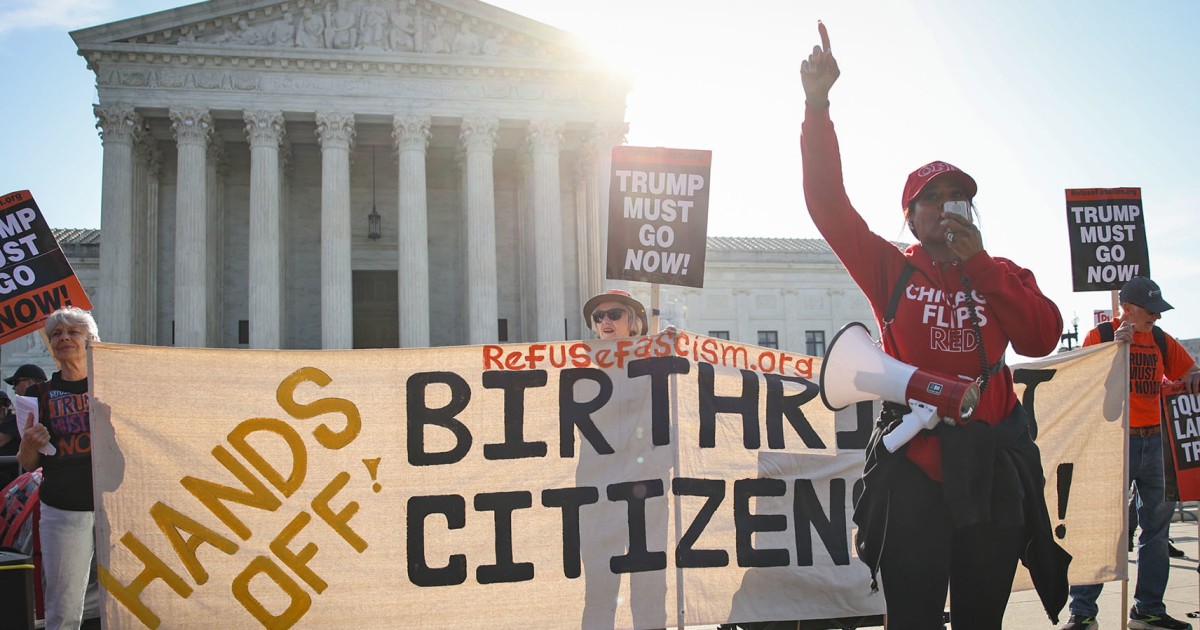
Birthright Citizenship in the Crosshairs: From NBC, the Supreme Court appeared skeptical of Trump’s attempt to limit birthright citizenship to only those born in the U.S. with at least one parent who is a citizen or permanent resident.
“It’s a new world. It’s the same Constitution,” Chief Justice John Roberts told Solicitor General D. John Sauer, who argued on behalf of Trump.
Carlos Berríos Polanco edited and published this edition of The Latino Newsletter.
The Latino Newsletter welcomes opinion pieces in English and/or Spanish from community voices. Submission guidelines are here. The views expressed by outside opinion contributors do not necessarily reflect the editorial views of this outlet or its employees.