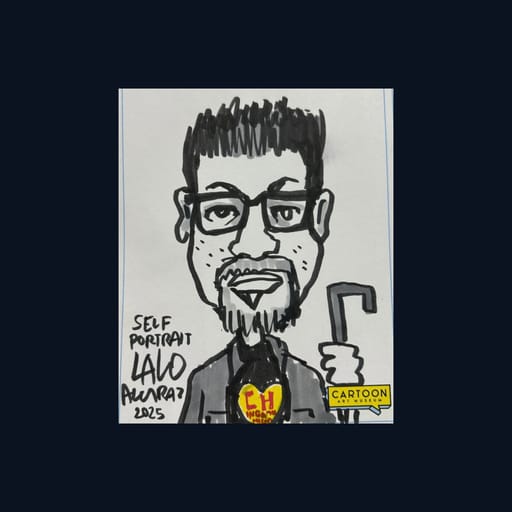
Transcript 0:00 [upbeat music] Welcome to the Latino Newsletter Podcast. I'm your host, Michelle Zacarias. 0:06 And today we have Lalo Alcaraz, who is a Chicano cartoonist, most known for being the author of the comic strip, La Cucaracha, the first nationally syndicated politically themed Latino daily comic strip. 0:20 Lalo has also worked on the animated TV show Bordertown, as well as The Casagrandes on Nickelodeon. 0:27 He has served alongside with Gustavo Arellano as a producer on comedian Al Madrigal's TV special for Fusion, Half Like Me. In 2015, Pixar hired Lalo to consult on Coco. 0:40 Uh, you've done it all, Lalo, so now we have the pleasure of being colleagues at Calo News together, where your cartoons have been recognized in the last year by LA Press Club's SoCal Journalism Awards. 0:52 So the question that I have for you is that there's anything you haven't done that you're still hoping to do? [laughs] I have my own show, although I'm getting close to running a show. Everybody light your candles. 1:05 But yeah, I've been, I've been knocking off my bucket list, so, um, it's been good. I'd like to win a Pulitzer fully. I've only gotten a finalist twice, uh, but I'd like to win one outright. 1:19 I was gonna ask, what are the two Pulitzer finalist cartoons that you were nominated for? Well, it's for a body of work, uh, for, uh, that year, so you'd have to look at the whole... the 15 comics you submit. Mm-hmm. 1:33 Most contests are kind of like that, you know. So- Okay. Okay. So we're- I think I'm on a roll this year... getting closer to the win. Can you- I can smell it. 1:43 [laughs] Can you tell us a little bit about your work, your upbringing, for those who might not be as familiar? You know, you grew up with your Chicano identity influencing your artistic journey. 1:55 Can you talk a little bit about that? Sure. I grew up, uh... I had, uh, I had it all for, you know, 2:05 kind of, uh, growing up, because I grew up on the border in San Diego, California, and my parents are Mexican immigrants from Sinaloa and Zacatecas. 2:16 My mom was undocumented at the time, at, at a certain time, not the whole time, until she wasn't, you know. 2:23 And then my dad came over with the Bracero program, entered through Texas, and made his way to Southern California, and my parents met 2:33 at ESL class at the high school I would eventually graduate from 20 years later, Helix High School in La Mesa, California. And so, which all those things educated my outlook on, my artistic outlook, my political outlook. 2:50 I got to grow up with my immigrant parents and be treated exactly the way they were. I, you know, worked with my dad doing gar- landscaping or whatever you wanna call it. Uh, 3:05 m- I would go with my mom to clean middle class white people's houses in, in San Diego, where, where I used to think they were mansions, these, like, houses, 'cause they were so much bigger than the shack I was living in, right? 3:17 And so I saw it all, and then I saw how people were mistreated on the border. When you grow up on the border, you go back and forth. 3:25 Y- y- so we would go to Tijuana all the time, every two weeks or every week, and that's where I picked up my love of comics, really in, in Tijuana, seeing, like, newsstands with comic books, Donald Duck in Spanish, you know, which, like, that influenced me a lot. 3:40 Reading Disney stuff in Spanish kind of blew my little brain, you know? Like- [laughs]... it made me just crave more comics in any language. 3:50 So all of that, and then growing up in San Diego as a Chicano and working with Chicano artists and having Chicano artist mentors, that kind of led me to editorial cartooning somehow. Weird path. 4:06 I was gonna ask, 'cause, you know, there is a couple of steps there between seeing and enjoying comic books and then deciding, like, "Wait, I'm gonna pick up my pen and draw something." 4:17 What would you say, I guess, are some of the specific moments where you realized art could be used as a tool for activism or storytelling? It's always storytelling first, I think. I always drew. 4:33 I used to tell people I used to draw in the womb, and that was very painful for my mother. Like, [laughs] it was like cave drawings in there. And I had the ability, and it kind of runs in my family. 4:44 Like, art runs in my family. We have a gene through my mom's side, the Sinaloa side, and [laughs] I always say on the Zacatecas side, I got alcoholism, that gene. 4:55 And, uh, I would be that kid in, in school that didn't pay attention in class and would draw on the margins of the paper. And luckily, I had some teachers that recognized this and encouraged it. 5:07 Like, instead of s- trying to stop me, they encouraged it, and I had a round of good art teachers and teachers that weren't art teachers but that still nurtured that. And so I highly respect teachers. 5:23 My, my wife's a teacher, school teacher, elementary, and I got to thank a couple of the teachers before we all got too old and tell them, like, "You changed my life." 5:32 And then as I grew up and, and I became the editorial cartoonist in college, which every editorial cartoonist you meet, that's where they started pretty much, you know? 5:41 And that's, that's where I started doing a regular thing where people would give feedback and write hate letters and stuff in college at San Diego State. 5:51 I used to do cartoons against school spirit and, and the frats and all that 'cause I hated all that. And so I would generate a lot [laughs] of hate mail, and a lot of it was racist. It was great. 6:03 It was the kind of proving ground. And that... But that's where I noticed that-Wow. You can, uh, you can have an effect on people. You can get inside their brains, really screw 'em up, you know? 6:14 Would you say that helped build up your tolerance for your current giant fan base [laughs] and their loud opinions? It took a long time because it is freaky when you get, like, a threatening letter. It, it is not cool. 6:28 Now it's, it's very commonplace, but it's still bad. You know, I mean, it's not good for people to get nasty comments on the internet or to get direct messages. But we all have a little taste of what this is like. 6:40 Imagine someone constantly calling you up, telling you they're gonna beat you down when they see you in the street or something, or they're coming after your family, or just threats. It's mostly empty threats. 6:51 But once in a while, you gotta look out. And, yeah, it took me a long time to kind of just start laughing at it, and it became amusing. They say the same thing over and over again. Yeah. 7:01 I was gonna say, you know, I notice every time you post, there's, like, always a strong reaction, whether it's positive or negative. Like, people seem to be anticipating you'll say something or do something. 7:15 And, like, in a moment like this, where there is so much, like, at stake politically, how do you balance inserting something like funny commentary into your cartoons? 7:26 It's funny when, like, I'll do a cartoon that is super, like, hard-hitting and serious and, and barely has a punchline. It just has, like, a ma- big point. Like, so- socks you in the gut or the face. 7:41 That's when people will write, "This isn't funny, man." [laughs] Like, yeah, no kidding. It... That's not what I was going for in this one. You can't hold me to that standard each time. 7:53 I'm gonna try to be silly and funny 'cause I, I like being silly and funny. Sometimes that's misinterpreted as callousness. Sometimes a reaction is weirdly wrong, and, and that's okay. 8:07 I got a big compliment when I was at a cartooning convention in Maryland. 8:15 A master cartoonist was breaking down one of my cartoons on screen, ch- my Charlie Kirk cartoon that I did, and, uh, he was like, "Lalo should be the co-president of cartooning because this cartoon is this, this, and that." 8:27 But the biggest compliment was, and he gives the reader, makes the reader do a little work, makes the viewer work a little to get the cartoon, a complete idea. 8:39 Even though I do blunt, direct cartoons, but I don't like to just lay it all out there so that it's like a ABC. You know, you, you gotta work a little bit. 8:47 You gotta use the coco that God gave you, which is what my mom used to say all the time. 8:53 I mean, you've done so much over the course of the years, and obviously you are an artist, but you've also contributed to projects like Bordertown and The Casagrandes. 9:04 How is it different working on television versus, like, a political cartoon? Oh, yeah. Well, 9:12 good question 'cause Bordertown is a bad example for this question because it was like a political cartoon, yet we were still a little throttled a little bit by the network. 9:26 It still had standards and practices, and there's some stuff you can't do, uh, on TV. But on kids TV, like Nickelodeon, The Casagrandes, you can't do a whole lot of stuff. 9:39 But it just makes you work harder, come up with a different joke that works or in that situation. It, it's just more challenges to your abilities. 9:49 So if you're a good artist, you shrug it off and keep going and try to figure it out. 9:55 The other thing that I think is really interesting is, like, over the course of, like, all the decades that you've worked, obviously you've always represented for Chicano identity. 10:03 But I'm wondering whether you feel like representation of Latinos or Chicano identity has changed over the course of those decades. 10:12 Do you feel like it's more inclusive, or do you feel like you're kind of running into the same sorts of barriers? Depends on the situation. I mean, obviously 10:22 there was that weird moment wh- of, uh, it was a few years ago. A- and mo- most people don't even care about this because they're not, like, academics or maybe they didn't even go to college. 10:32 Mexican hegemony was a thing, this, like, theory that, uh... You could tell a total academic came up with it. But it was, like, anti-Mexi- like, basically it was like, there's too many Mexicans. 10:44 And it, and this was, like, propagated by, like, Central American, uh, academics i- in the US. 10:51 And it's fine as an opinion or whatever, but they really, they tried to use it as, like, a, a hammer against Chicano studies and Chicanismo and everything. And there's 110 million Mexicans, you know. What are you... 11:04 [laughs] Of course most things are gonna be about Mexicans, you know, in the Latino sphere, right? Yeah. And of course we try to recognize everybody. I try to. 11:15 And there's, like, a diversity in the way that Mexicans are also represented, or there should be, right? 11:19 And I, I had mentioned this to some of my friends out here, was like, you know, I spent most of my childhood seeing depictions of Chicanos and Mexicans that were very, um, West Coast adjacent, because that's where- Yeah... 11:33 the media is. Um, but- Yeah... Mexicans in Chicago aren't necessarily like that, and Mexicans in other places, so. Yeah. Yeah, there's so much diversity even within, like, one demographic. Yeah. I love it. 11:45 There's, you know, there's Chicanos from Puebla, and there's Chicanos from... You know, if you're in LA, half the people are from Zacatecas, you know, like [laughs]... And I'm half Zacatecan. 11:55 But I know a professor, I know a professor that calls himself, like, Zacatecan. He doesn't... You know, it's like they, they, they take the nationalism argument way over the top. 12:09 And, and-I know it shouldn't annoy me as much, 'cause normal people don't think like that, you know? Like, regular people, that's the people I'm trying to reach. 12:19 I like that I have a big middle-class older audience, 'cause they have jobs. They can buy my merch. That's great. But I wanna reach everybody, and it would be nice, you know? 12:31 And I'm trying more to represent than to change their minds, you know? You know, I'm trying to rally, you know? Like- Yeah... 12:38 and, um, that's what I'm doing politically, I think, with, uh, my, my, my extracurricular stuff like this, you know, which is not in any of my editorial cartoons. 12:49 It's more of a I wanted to make a, a bunch of prints on this. But there's another project actually I'm working on, 12:56 but we can talk about that a little later after we, [laughs] after we solve all the problems of Mexican representation. 13:01 I was gonna say also that, uh, generationally with Mexican-American people, I've s- because thanks to the, the internet, thanks to social media, I've s- I've seen that people started calling themselves just Mexican i- in the US, and that's super interesting to me. 13:21 And that kind of, like, has made stuff go a little broader, you know? Like, uh, against the tide of the Zacatecan Americans, uh, and the Sinaloan Americans. 13:34 Uh, and, uh, a- and, and so that, that's been kinda cool to see young people embrace that, and embrace the flag and immigrant debates and, and- Yeah... just get, be political, you know? 13:47 It's b- it's been, like, I, I don't, I don't care if you call yourself Chicano or not, you know? That's just, the, the label's for me. Hmm. 13:56 You know, it's so interesting that you say that you know you have this following of kind of like middle age, working class, like, older fans. 14:05 Do you see, like, a new wave of younger Lalo fans coming out, or have you seen mostly the same fans just growing with you? N- uh, no, I've seen both. 14:18 I, I mean, I, I, I don't wanna sound like I'm trying to brag, but I do actually... I mean, the, it's, [laughs] and it's mostly like, you know, people... I really love it when people come up and say, 14:29 "My grandma turned me onto your comics," you know? [laughs] It's like I feel, like, 1,000 years old at that point. [laughs] But kids are reading the stuff, you know? The parents are like, you know... 14:41 Some, so I met a, a kid who was like, "My parents forced me to read your stuff." [laughs] I'm like, "Oh, I'm sorry." They're like, "No, it's cool with, I like it." 14:50 So, um, and then, you know, I've, I've been, since, you know, newspapers have been collapsing, I've been just, I put everything online, not behind a paywall, you know? 15:01 Like, I put it out there so that people share it, read it, and that has helped a ton. Um, so- Mm-hmm... you know, I don't, uh, I don't have a Substack or anything like that, so. 15:13 Uh, I'm too disorganized to have a thing with premiums and s- shit, you know? [laughs] Like, I c- I can't. 15:20 I mean, you have a pretty meaty Instagram following, and social media has definitely, you know, felt very active for you. Are you a fan of the accessibility that social media provides? Are you... 15:34 'Cause I know you said it can be really alarming when people go very hard in the comics [laughs] or- Yeah. [laughs] Oh, yeah, especially when they misunderstand something. It's like, "Ugh." Or they... 15:47 Like, I usually won't write anything if they're coming at me. I just let 'em go, because I've seen it before 1,000 times, and they're not very clever. 15:54 But when people misinterpret and, like, reshare it with a totally mistaken take on it, you know, then I'll write and overexplain what I was trying to do usually. I just c- I hate that. I can't stand it. 16:10 Otherwise, you know, it's, it's, it's a, it's a benefit. Social media's great. It, again, uh, you know, peop- like, I agree with the 16:19 statement that social media's allowed stupid people to communicate with each other, and that's bad. [laughs] That's why we're in the situation we're in right now, uh, since 2020 and the pandemic, you know? Yeah. So. 16:35 Do you also feel like it's given smart people the opportunity to connect with each other, or creative people? Oh, yes. That's been great, uh, of course. Uh, but, uh, that is a benefit, uh, you know. 16:49 [laughs] The other, the other thing not so, not so hot. Yeah. Would you say... 'Cause I know you mentioned earlier, like, you 16:58 had a lot of, I guess, like, um, mentors or people that you looked up to when you were first kind of, like, sh- diving into your own creation and artistic process. Um, how do you feel about that in this moment? 17:14 Like, is there any advice that you would give to a young Chicano artist who's trying to break into this medium? Yeah. The landscape is completely different from when I started. 17:25 I mean, I ha- you know, all analog and having the bare- barely having, like, you know, the beginnings of the internet to, to... It wasn't big enough to really publicize [laughs] stuff, you know? 17:38 Email was, like, exciting, you know? [laughs] Like, that was, like, you could communicate with all kinds of people that you never met before, and then it grew from that. 17:46 But, um, you know, I mean, I would tell, uh, young people, like, uh, you know, just keep doing what a artist would do. 17:55 Uh, you know, draw all the time, uh, create all the time, um, and, uh, open your eyes and ears and brain to other ways of thinking, uh, and have that inform you. 18:10 Um, and, uh, uh, you know, uh, I, I live by the, uh, uh-You know, uh, a good artist borrows, a great artist steals. 18:22 Uh, and, uh, because, uh, the great artist stealing will, that artist will improve whatever they stole, you know. Uh, and, uh, and, and that's just how y- art and literature's made. You know, music, uh, you just build. 18:38 Uh, and so you gotta keep your eyes and ears open and... But mainly, I- I'll say just keep drawing, and if you're meant to for this, you're, y- it's a life sentence, you know. You're doomed. Follow it. 18:51 Speaking of stealing, do you have, um, thoughts or opinions about, you know, sentiments that, like, AI art, it can replace, say, like- Do I? [laughs] Yeah, man, I've, I've, I've been really, uh, 19:08 um, uh, ev- any, any time I, uh, a- any chance I get to post against people making flyers and making posts, uh, with AI, uh, you know, mostly cartoons and stuff, I feel like that is... 19:25 That's sad, you know? It's, and it's like I know people like to play with gadgets and, you know, tech, but it, it bums me out to see people like, "Oh, here's, here's something I created." Uh, no you didn't. 19:38 [laughs] It's r- you know, it's more like I created it and the machine sucked it up and spit it out in this other format. Um, and I'm a human, flesh and blood, and, um, that, that bums me out. On the flip side, 19:53 I like, uh, apps that, that will help you make a song, you know, 'cause, uh, I, I will use those to write comedy songs. 20:03 You know, I wr- I write it, I just need the music, and I don't have that skill set, so I steal [laughs] it from that. 20:10 It is totally a, you know, it's derivative and it's not anything original, but that's not the point for me. 20:16 For, the point for me is just get some backup for my silly, funny song about Kristi Noem, uh, don't let her in your home 'cause she'll- [laughs]... she'll blow up your porcelain, you know, uh, your, your, your toilet. 20:29 And, [laughs] um, or, uh, I did a Trump song the other day, uh, which was pretty good. 20:34 But, um, I also have friends that are musicians, so if I really wanna make a song, I'll, I'll, you know, call them and, and I'm actually gonna do something like that for this new project I'm working on. 20:46 Which you cannot share more about quite just yet, correct? Not yet. [laughs] Oh, no. Nah. Well, that applies to the TV project I'm working on, which I- I'll, I'll talk about that for a second. 20:59 But the, uh, TV project I'm working on, I'll be the showrunner for this animated show. Uh, and, uh, I think it's a no-brainer. It should sell. It's a, a very well-known social media IP. 21:14 Uh, and, uh, it's be funny as hell, and I'll probably get canceled 10 ways to Sunday, uh, w- if it goes through. And I'm looking forward to it so much 'cause it's so funny. 21:28 Uh, and it is just my, you know, um, sense of humor. And, um, it's funny, the other day I was in some other meeting and they said, "Oh yeah, uh, 21:41 people that write for kids television wanna do adult television so bad," uh, you know. [laughs] And I'm like, "That's me. That's me. I like to write offensive jokes. Uh, get me in trouble all the time." 21:54 Um, but I, I was just se- se pasan on the internet because, you know, [laughs] like I... The, what I remember is I wrote some joke about something and I said, 22:09 I, I probably said, uh, chinga tu madre, and oh my God, I got lectured about, by the language police about, "You shouldn't use that, um, because it's, you know, offensive to mothers and women." 22:23 I'm like, "Well, that's why it's offensive, you know? 'Cause it's about your mom, you know?" It's like every culture says, "F your mom," or, you know, whatever. That's, that's what hurts a person. 22:35 So, uh, I, I, sometimes I just, I, I lose my, I lose my mind o- on this stuff. But, um, anyways, language police, leave me alone. I'm gonna do- [laughs] I'm gonna do what I'm gonna do. I, I don't care. 22:48 I don't care how, how hard you cancel me. But, um, so that's, yeah, I am gonna ask my friends to write music for this show, if we should be so lucky to sell this show. But, uh, then, and I know so many... 23:00 I know, like, I've, I've worked in, in Hollywood since the '90s and, but I, I, I pretty much know every Latino that works in Hollywood, even the kids. 23:12 The other day you s- you might've seen, I gave an award to, uh, Xolo Maridueña. Uh, Blue Beetle, right? Yeah. Cobra Kai guy, you know? Cobra Kai, yeah. He's like, his uncle is, like, my friend who's a Chicano artist. 23:26 [laughs] Uh, Jose Ramirez. I was like, "No way. Are you kidding me?" A- and then his, his mom was like, "Yeah, I think you met Xolo when he was, like, in diapers, you know?" And I'm like, "Yes. 23:39 I, I'm pretty sure I saw him running around his, um, his tia's store in, in, uh, Eagle Rock." And she had a bookstore. And, uh, anyways, world is so small. 23:50 But, uh, I do know lots of people and I can, uh, or, or, and I have friends that can call people, uh, and, and ask them for favors. 23:58 Which brings me to this next thing, which is, uh, a music album called Contra ICE, and it's a musical compilation album. 24:07 It's a benefit, uh, for, uh, CHIRLA, Unión del Barrio, and, uh, National Day Laborer Organizing Network. 24:17 And, uh, we're gonna, uh, do a musical compilation album.At least one volume, probably two, 'cause we have so many people who wanna be on it. And we're gonna do a concert next year. Uh, and, uh, and we got 24:32 really big names on this. It was a brainchild of, uh, Ulises from Ozomatli, and, uh, it's got Ozo, Los Lobos, Tom Morello, Jello Biafra, I think, has signed on, the, uh, famous punk rocker. 24:50 Uh, we're trying to get Henry Rollins. We got Las Cafeteras. We got all these other bands, I have no idea who they are, uh, 'cause I'm not a hipster. And, uh- [laughs]... 25:00 and we've got, uh, and we've got f- for comedy, we've got, uh, Fred Armisen from Sat- Saturday Night Live, CholoFit, Creeper. [laughs] He's great. Um, and, uh, and, and more, and, and more people. 25:14 And, uh, I'm the art director on the project. It's been, uh, really cool so far. It's really taken off, and it's gonna be a thing, you know? Uh, si los quieren. 25:24 Yeah, we've got engineers, we got all kinds of famous rock stars that are helping out with engineering, and secret donors helping with the money, and- [laughs]... it, it's a cool thing. 25:35 So, um, and I'm gonna have, uh, I'm gonna have a, an ICE recruiting, uh, sketch on there, uh, on, that, where I'm gonna do all the voices. 25:45 [laughs] And I'm gonna tweak them with artificial intelligence, so I sound like Kristi Noem. 25:50 [laughs] You know, just looking back on everything that you've worked on, everything you're hoping to continue working on, um, what kind of legacy do you hope that your art leave behind in your community? Hmm. 26:05 Well, first I was gonna say, uh, I don't know if I can work it into the answer. 26:09 Uh, but, uh, it has been great, uh, and I've been so privileged to work on Caló News, uh, where, um, you know, my, my, my bucket list included being the editorial cartoonist for the LA Times, right? 26:22 And which is not happening. Uh, they don't have editorial cartoonists there anymore, and they're not gonna have any. Uh, and, uh, and I've asked. 26:30 [laughs] And, um, but I'm, I'm doing a very close thing, uh, to it, which is having this platform, Caló News, where we report on local news, on Latino news, on regional news. 26:45 Uh, and I get to draw cartoons about pretty much anything, uh, I want. And, uh, you know, I'm always trying to find the local angle, or at least the Southwest angle on things. Um, although I would... 26:57 I, I have, I admit, I've drawn t- way too many ICE cartoons, but- [laughs]... ICE is part of our lives right now, so, uh- Yeah... you know. 27:06 But, um, and my legacy, I hope that, you know, people want to use critical thinking and wanna stop just believing everything that's on the internet, and maybe using the coco that God gave them. 27:18 And I hope that my, my cartoons help with that. I, I do get told by teachers, uh, when I go across the country, "I use your cartoons in my class to..." 27:28 You know, and they're high school teachers, and college, and, and, you know, the, "We have a weekly, you know, cartoon of yours and some other ones, and we talk about the news." 27:38 And that, editorial cartoons have been used for that for decades. You know? 27:42 The- they're great for that because they, um, capture, they chronicle the moment, uh, of, of, and a, as, and a point of view on a story, uh, like, like, like a 1,000-word essay just can't. You know? Uh- Yeah, mm-hmm... 28:00 no offense to my, all my writer friends. Um, but I al- [laughs] I taunt them and I say, "A picture's worth a thousand words, so I have outwritten all of you." [laughs] And [laughs] I'm gonna keep going. 28:13 But, uh, yeah, I hope that people also will see the history of the times. From when I started editorial cartooning, the issues were, you know, uh, um, a not... 28:24 the on steroid version that it is now, but, you know, grow- when I was in San Diego, it was like, it, violence at the border. It was racism, it was racial profiling against Mexicans. Um, and, uh, all those things, 28:40 we got 'em in, in, you know, we're overly blessed with those now. Uh- Yeah. Yeah. So, uh, I hope people can draw that line and see how it progressed, if you wanna call it that. 28:51 [laughs] Well, thank you so much for being here with us. Um, we appreciate your scathing comics, your social critiques. [laughs] Um, we love to see your projects coming out, so definitely keep us posted. 29:05 And thank you again for being here. Uh, it was, uh, my pleasure. And as you can see, I cleaned up my office just for you. [laughs] Thank you so much. 29:17 [upbeat music] This episode of the Latino Newsletter Podcast was produced by Joaquin Cotler, Juan Diego Ramirez, and Michelle Zacarias. It was edited by Julio Ricardo Varela. Music by Cast of Characters via Soundstripe. 29:32 Season 2 of the Latino Newsletter Podcast was made possible through individual donations and the Latino Media Consortium. 29:38 The views and opinions expressed in this podcast are those of the guests and host, and don't necessarily reflect those of the Latino Newsletter or its staff. [upbeat music]