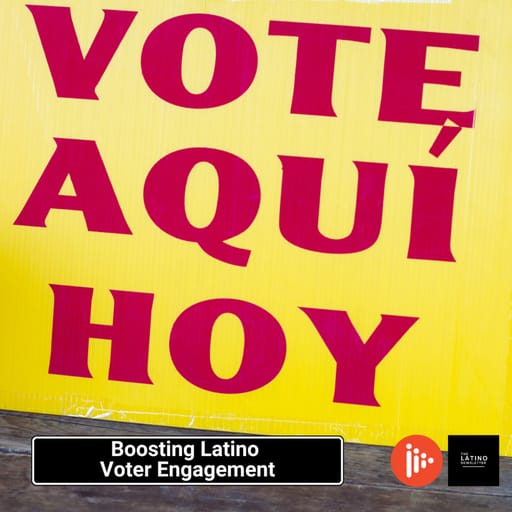
Transcript 0:00 Hey, it's Julio Ricardo Varela of the Latino Newsletter Podcast, and you're getting a little bonus audio on our feed, on the Latino Newsletter Podcast feed. 0:11 What you're about to hear is story two of the Latino Election Project series that the Latino Newsletter produced with New England Public Media out of Western Massachusetts. 0:21 We're covering the election through a clear Latino lens in Western Massachusetts. 0:25 So here is a story about voting obstacles in Latino communities in Western Massachusetts that I produced with one of the amazing high school student journalists who worked with me on this. 0:37 So here is the broadcast cut of story two of the Latino Election Project. In the NEPM news studio with me is Latino Election Project student producer, Avani Santos. Hey, Julio. 0:50 So Avani, you are a high school student here in Springfield. You spend time on social media, yes? Yeah. And you wanted to share a TikTok with me? 0:58 There's a TikTok from Ohio showing a group of newly registered 18-year-old voters in high school going to vote early while a marching band played. 1:05 High school students who are voting for the very first time here in Dayton, which is really exciting. Uh, we're gonna march across the bridge over to the Board of Elections so they can cast their ballots. 1:14 [marching band playing] When I saw that clip, I was like, "Yeah, this is not what we're doing at my high school here in Springfield." 1:26 I noticed that many of my classmates are finally entering adulthood and realized just how many freedoms that come with turning 18. 1:33 So I started asking, "What are 18-year-olds in my school who are new voters saying about the election?" This is Izzy Martinez. I talked with her about whether she was excited to vote. She told me she was. 1:45 Yes, I believe our voice matters, and my voice matters, particularly to just my community on a small scale, because I'm just a high school student, but it's a lot more to that. 1:59 I'm part of a brand new high school, and there's a lot of new things that are going on in our city, and I feel like I've made great connections and been able to talk about my school a lot. 2:12 Having those opportunities to be able to speak about that, really important. And the more that you say something, someone will eventually listen to you. 2:21 Oh, so it means that they all feel ready to vote so that their voices are heard. Well, not necessarily. Sadie Rivers is 18 and also goes to my school. She says she feels a lot of pressure to vote. 2:33 Are you planning to vote in this election? I thought about it. 2:37 Like, I thought about not doing it because I did not want, like, people to shame me if I pick the wrong person, that the world and economy goes to, like, it's bad, you know? 2:47 So you feel like there's a lot of pressure on you as a young adult to make the right choice? Yeah, I do, because, like, a lot's to process, and, like, I don't know who to vote for, and it would be best for our world. 2:58 So young people may not want to vote? We do have some kind of encouragement towards voting. Sully Perez, also 18, told me that teachers are being helpful. 3:09 Definitely teachers are telling me, like, it's important that I vote now that I'm 18 and all that. 3:13 I do take a politics communication class at WNU, and I've been getting way more information than I usually would through that class. Western New England University. 3:23 Students in your high school can take classes there, right? And there are professors encouraging students to vote? Yes. This is Professor Bill Mendel, who teaches political science at the university. 3:33 You guys are kind of new to this, but it's... this may be the most important election I vote in in my lifetime. It really determines which direction the country's gonna go in. I wouldn't miss it. 3:45 Adults who encourage young voters to go to the ballot. Yeah, I guess. I mean, it makes me wonder. Voter turnout is still low in Springfield. 3:53 In 2022, during the midterms, only twenty-four point nine percent of voters came out, the second lowest in the state. Why? And you talked to Zulma Ly Rivera Delgado all about that. 4:05 She's with Neighbor to Neighbor, an organization that mobilizes communities of color to vote. Let's hear what she says. Once you're registered to vote, you're ready to go. 4:13 I think it's always gonna be a, a learning curve for students to know how politics work in their lives, because it's... civic engagement is not really a thing in, in grade school or the public education system. 4:29 But if you speak to students and you speak to 18-year-olds about their lived experience and start connecting how inflation is related to government, job insecurities, or the economy, how housing is connected, it depends on how much they really know, but the minute you're 18, you can vote. 4:51 Avani, you are not of voting age, but are you hopeful? I am. One of my teachers, Adriana Rua, shared some really good perspective. In a presidential election, you're voting for the next four years. 5:03 When you vote, don't think about the candidate that's in front of you currently in this time. 5:09 You're voting for the next four years, which will bleed into four to six years, because we will always have a back, an extension of what they do. 5:17 So even though at 18 you're in one place, don't forget that they're gonna be there until you're 22, and is that the person that wants to represent you? That advice hit home. It's not just one day, it's four years. 5:31 For the Latino Election Project from NEPM News and the Latino Newsletter, this is Julio Ricardo Varela. And this is Ivani Santos.