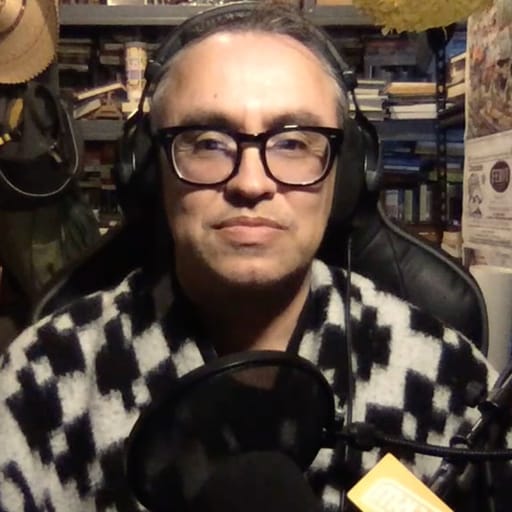
Transcript 0:00 [upbeat music] Welcome back to the Latino Newsletter Podcast. I'm your host, Michelle Zacarias, and our guest today is Gustavo Arellano. He is a columnist for the LA Times. 0:11 Gustavo was a finalist for the 2025 Pulitzer Prize in commentary and the Mike Royko Award for commentary and column writing. 0:20 And he was also part of the team that won the 2023 Pulitzer Prize in breaking news for reporting on the leaked audio recording that upended Los Angeles politics. 0:29 Gustavo previously worked as an investigative reporter and editor for the OC Weekly, where he wrote a column called Ask a Mexican and is the author of Taco USA: How Mexican Food Conquered America. 0:44 He is also the child of two Mexican immigrants and is now a renowned voice on all commentary relating to Latino identity and politics. Thank you so much for being here, Gustavo. 0:54 Gracias for having me and for the nice intro. You've built a career telling stories about Latino perspectives, um, which is something that a lot of the mainstream media outlets once overlooked. 1:07 How do you feel about where we are now in terms of Latino representation in the media? It's not nearly enough. It never has been enough. There's more voices now, yes, but there needs to be way, way more voices. 1:20 I mean, and not just, of course, in your traditional areas like the Southwest, like Chicago, like New York, but even in the smaller s- uh, you know, the, the smaller newsrooms, nonprofit and pr- for-profit, like there just needs to be more of us. 1:35 I mean, part of it also is that not enough people... I mean, 1:40 y-you cannot change things fundamentally until the people who are writing the checks and are making the editorial decisions are, have more Latinos 'cause you could play a big game and say, "Yeah, we like diversity and all that," but they're not hiring enough of us. 1:55 And then the worst of all, as we're seeing right now with the layoffs that happen at the beginning of every year, even when you're in a unionized paper, the early-- the last people in are the first people out, and far too often it's people of color. 2:10 And so the young, like the, the... basically, uh, news organizations are shooting their future away by laying off too many people of color, and in this case we're talking about Latinos, so way too many Latinos. 2:21 So it-it's, it's unfortunate. I'm glad though that you are seeing people like the Latino Newsletter Podcast, like yourself and so many others that we know saying, "No. We're, we're not gonna take it." 2:33 If the mainstream media, legacy media now that, now, now that's what it's called, if they're not gonna freakin' handle this, we're gonna handle it in our own way. 2:42 My challenge and my hope is that the f- the owners, the funders, and more importantly the listeners and the viewers and the readers step up if they want more Latino representation in news will support those that are doing it, you know. 2:56 Porque si no, what the hell are... Like, s-stop pretending that you care about your community if you do not actually support the people that are trying to 3:05 accurately represent our community, or at the very least document what's going on in our community. Yeah. Amen. Amen. 3:12 It's definitely one of those situations where I'm seeing so much talent across the board from Latino journalists, reporters. So many of them are either experiencing layoffs or are not paid equitably, right? 3:23 Like you're not- [laughs]... seeing them move up in ways that they should be moving up. So I think you hit it right on the nose. 3:30 I'm wondering for you, 'cause you've been in this game for a while, as a columnist for like the LA Times, how do you balance between like the personal and the institutional expectations? 3:42 At the end it's just my expectations. 3:44 By the way, I have, because I'm a veterano at this point, I've been at this for 25 years, and the way I started, like I have a lot of privilege in deciding what I can do and can't do that I frankly think more [laughs] reporters should have, and sadly not enough of the people in charge allow. 4:01 So I was at a newspaper that no longer exists called OC Weekly, and the la- for 17 years. The last six years I was there as the editor. So I got to be the person in charge, and I got to make my own way. 4:13 When the Los Angeles Times hired me in 2019, like look, I knew it. The LA Times, it's one of the great newspapers in the United States and also has a lot of institutional baggage, especially when it comes to Latinos. 4:25 Um, and so I told my bosses like basically, "Look, I thank you for the honor, but if we're gonna do this, it has to be done the way I wanna do it. 4:34 And of course, like you have to approve my ideas," and I've always been lucky that 95% of my ideas get approved. It's like the last 5% that we always fight over, but in a, you know, play those in a good way. 4:45 But um, so I really just see myself as like this is who I am, this is my voice. I am, you know, the proud son of two Mexican immigrants. My dad came to this country in the trunk of a Chevy. 4:55 My grandmother basically was a child of refugees from the Mexican Revolution who was born in Arizona, so I have that privilege as well, and also being born in this country. So I wanna tell those stories. 5:06 I wanna tell my stories, but I also wanna tell the stories of other people because for me, look, I could give you my opinions on things. 5:12 I'm not always gonna be, um, Guangdong said, in alignment with everyone, but no one ever should be in alignment. 5:19 So that's why more than any-anything, I wanna focus on the stories of others, tell those stories, and then hopefully make... people can do what they will with those stories and that perspective. Yeah. 5:29 I think that's a really important point because you're, you know, you say you ultimately are answering to yourself, but a lot of people look at you as like a representation of like the Latino voice, which is really difficult, right? 5:41 Because Latinos are not monolithic. You cannot do that. How do you, I guess, handle the pressure of sometimes feeling like you have to represent, uh, the demographic? How do you navigate that pressure? 5:55 By not feeling that pressure at all. Like look, it sounds selfish when I say I don't feel that I have to be a representative for anyone 'cause people say like, "Oh, you represent the Latino community." I'm like, "No. 6:07 I am-A voice. I do have a prominent platform, absolutely. So in that sense, yeah, I better not be too stupid when I do things. Or the things that I say. 6:19 And look, like some-- Again, like I've done coverage that people do not like, that the, you know, como se dice, the, the, the Latino leaders at large or activists have not liked. 6:29 And they'll say like, "You know, you need to be a better representation for us." 6:32 And my response to that is like, "I'm telling you stories, and if you don't agree with them, then that's fine, but like listen to what I'm trying to say instead of just focusing on me and what you think I should be saying." 6:45 And so for me, that's why I do... When, when it comes to what Latinos are, I do try to do as much of a range as possible, especially in a city like Los Angeles, but also just, you know, across the country. 6:56 And I think at the end, if I am a representation, whatever people may make of it, well, to be the best representation possible, I have to be the most authentic me. And I mean, again, who am I? 7:09 Child of Mexican immigrants. That's like Zacatecano, if you wanna get even more down to it. Like that is my identity. The, uh, Spanish was my first language. 7:17 I grew up in a community, a diaspora community of people from the Municipio Jerez. Yeah. Where undocumented folks, we didn't even think... Like sadly, we didn't think of it until like it became an issue. 7:28 Like someone got deported, or someone couldn't get something because they weren't a citizen, because we saw each other as, uh, humanos, you know, just people. 7:36 And then after that, just like, you know, being of Southern California, Orange County specifically, and just all these different things. 7:43 I think at the end, if you wanna take me as a representation of Latinos, well, you're definitely getting someone who has a lot of stories to tell just based on who they are. And that's one thing I will never be. 7:54 I will never not be me. Mm. So part of the reason that I asked you to come onto the podcast today, Gustavo, is to discuss colorectal health. And this is an issue, as you know, that's near and dear to my heart. 8:09 I was diagnosed with colorectal cancer in 2024 at the age of 34. 8:15 And this was like such a jarring experience for me because it was the second time that I had been diagnosed with cancer, but it was a completely unrelated new cancer I had no prior experience with before. 8:29 And the more I learned about colorectal cancer after my diagnosis, two things became really apparent to me. One, Black and Latino communities are disproportionately impacted by colorectal cancer. 8:43 And two, the last decade, the rates for colorectal cancer have doubled for people under the age of 45. And this is extremely shocking, right? Like this is a, a really huge increase. 8:57 Um, so I, I was really appreciative of you being able to kind of like talk about your colorectal health journey, um, because I know it can be really uncomfortable and vulnerable for folks. 9:07 Um, and you spoke publicly about how you gifted yourself a colonoscopy for your birthday recently. Yeah. Can you talk a little bit about that? Yeah. 9:17 And kind of relating back to what you said, like how do I feel about, you know, representation, b- me, me being representative of Latinos. 9:26 The one thing that I really, in doing this column, columna now for the LA Times for five years, that where I've seen that I could really have an effect, and I'm really proud of the most, is health. 9:37 And it was something that I never sought to do, but it is very, very personal to me because when I joined the LA Times in 2019, my mother was dying of ovarian cancer. She, she complained about pains in... 9:51 You know, just pains for years. And the medical profession dismissed her. "Oh, it's gas. Oh, es nada." This, this, and that. 9:59 And she was trying to keep up to it, and she was insured, and they just dismissed her because she was a Mexican immigrant woman. 10:06 Finally, when she got diagnosed, literally from the diagnosis to her death was like a year and a couple of months, and it was horrible. 10:13 Just such a tragedy, something that I will-- my family and those who knew her will never, ever get over. 10:20 So like, you know, just a couple months into my time at The Times, I had t- I like, I wrote an obit- basically an obituary, a commemoration of my mom. 10:29 We're, you know, we're talking ya, ya es Lent, Cuaresma, so I talked about how, her capirotada. And like that was always my favorite dish that she would make, and she would never be able to make it again. 10:38 But I learned how to do it, so I'm glad to say I'm able to make it. 10:41 But after I wrote that, yeah, I got so much, you know, so many letters of condolences, but also telling me, "Thank you for talking about ovarian cancer." 10:50 Something I thought I would never have to talk about because, you know, like wh- when we ta- like when we think about cancers, at least among Latinos, like, you know, the breast cancer, of course, uh, uh, bone cancer or leukemia, uh, prostate cancer. 11:04 Like, just in my mind, uh, that's what I think about when I think about Latinos. I never thought about colorectal cancer, but we'll get to that in a little bit. 11:10 And then, um, during the pandemic, I talked a lot about my dad, who originally did not wanna get the coronavirus, uh, vaccine. Porque esto, y esto, y esto. 11:20 But so I talked about that experience, and I got so much good, uh, feedback from folks saying, "Thank you for talking about those stories." And as a columnist, honestly, I don't really wanna talk too much about myself. 11:31 Not that I have anything to hide, but I'd rather, again, tell the stories of others. Like, I'm 47 now. 11:36 So when I got my physical last November, I was still 46, and my doctor said like, "Hey," like, "remember I t- I, I scheduled the colonoscopy for you. I even sent you the take-home kit, but you didn't do anything with it. 11:50 Like, you should do it. Like better safe than sorry." And then I'm like, "You know what? Yeah, okay, fine. L- fine, let's do it. Ya que se calle." And then I thought, "You know what? 11:59 I'm gonna write a column about it one way or another. Just whatever happens, and hopefully it's for the best." So that's what I decided to do. I told my bosses, like, "Hey, can I..." 12:07 You know, "This is what I wanna write about." Because I always thought of colorectal cancer as a older person's disease. I'm not even talking about 55. I'm talking about people in their 60s, 70s, o eso. 12:18 Never thought of it as a young person's disease, let alone your age, my lord, like s- mid-30s.And so then that's when I started doing the research as yours. 12:26 I'm like, "Okay, so a lot of people are uncomfortable with it," because Americans, anything involving, uh, the health of your butt, for lack of better term, and everything inside, like, we get all uncomfortable about these things. 12:38 It's just such an American thing, and, like, people wanna say, "Oh, it's a Latino thing." It-- We have our own issues as well with that, for sure, but really it's an American thing. So yeah. 12:47 Right, so I'm like, "All right, doctor, what do I have to do? Let's do this," and ahí vamos. Yeah. Yeah, no, I definitely agree. There is something distinctly American about, like, the discomfort with vulnerability. 12:58 I also think it is cultural, right? Like, I do think it, especially for Latino men, like, there's a lot of stigma there. 13:05 So a- as I'm reading the updates about, like, the demographics of communities are, that are impacted by this, it, it kind of lines up. 13:14 Culturally it lines up, um, but like you said, it's-- the tragedy is really that a lot of this is so preventable, right? 13:21 Even in my case, I mean, I'm someone who had already had cancer, so I advocated really hard for myself, um, and it was nine months before I got my diagnosis. And I'll never forget that- Geez... 13:33 because I am someone who had been through this before, I'd been through the medical system, and I pushed so, so hard, and I, I remember I went into the GI, and at that point, my symptoms were so bad. 13:44 I mean, I was eighty-four pounds. I ha- you know, had been experiencing stool changes, uh, digestive discomfort, fatigue, all of the, like, standard symptoms. 13:59 Um, and I was at the GI, and he was like, "Oh, it looks like maybe it could be an autoimmune disease or something. Like, we'll schedule a colonoscopy, like, two months out." And I broke down sobbing, right? 14:10 Like, I broke down because I had to basically, like, put everything out on the line and say, "I'm not gonna survive two more months of this," you know? And it shouldn't have had to be that way. 14:21 And I, and I really, I think about your mom and, like, being an older woman navigating the healthcare system, your mom being an immigrant, and the, like, barriers, right? 14:31 The language barrier, the way that women of color are dismissed in the medical industrial complex. All of those things compounded, all while your body is experiencing some of its lowest moments, right? 14:43 And that's why I'm so loud now. I'm always like, "Get your colonoscopy. Demand infl-- Over-inflate your symptoms if you have to, to get them to take you seriously." 14:52 Um, but I, you know, I saw when you did yours, you, uh, actually discovered some polyps. Tell me, walk me through that. What-- Were you experiencing anything prior to that? I've always had pains in my stomach. I... 15:07 And, and yes, like, and again, I wanna talk about privilege because you were dismissed, my mom was, my mommy was dismissed because you are Latina women. Me, I will be less dismissed 'cause I am a man. 15:20 I'm a cishet man specifically, Latino. And so I, I w- so when I go to the doctor, I will tell him, like, "I know my body. This is how I feel." So I wanna say... Well, 15:33 ever since I became a reporter twenty-five years ago, I've always had a pain in the exact same spot, like near my gallbladder. 15:39 And I'm also a hypochondriac, so I always tell the doctor, "Hey, hey, hey, this hurts, this hurts, this hurts," and it comes in and out. So last year they, uh, they scheduled the screening for my gallbladder. 15:50 Everything was fine. My levels were fine, all of that. So I've al- so I was, "Uh, it must be the stress of my job, maybe my diet, but not really." Like, you know, my alcohol, yeah, I like to drink, but no. 16:04 Like I, I know when I drink, when I drink too much, where that pain comes in, and I try not to drink that much anymore anyways. And then same thing with stool. 16:10 Like, you know, sometimes you eat something, it comes out different. Sometimes you eat something else, it comes out different. So there was nothing ever that would sound any alarms. 16:19 So for me, you know, set up, you follow the whole diet. You basically slowly start eating less and less and specific, uh, food, which is fine for me. I just ate a bunch of miso soup, which I love. Así, fácil. 16:32 Go through, through. The day before you fast, and then you drink that prep, like this bi- four liter jug of something. And I know you said earlier that you thought it was disgusting. 16:44 Most people thought it was disgusting. Maybe it's different brands I got. I think it's Gavilyte, the one that I got. 16:49 But then they gave me, like, this little, uh, un paquete, the powder, so it made it taste like citrus, like citrus blossom water. 16:56 You know, like if you ever have baklava, it's like a thick thing, and you drink it chilled. I'm like, "Oh, this is really good." 17:01 But the problem, like I wasn't scared of the aftermath because, you know, it's nature times eleven. I knew that was gonna happen, uh, so I stayed home. I had to go to the restroom a lot until you're completely empty. 17:13 But the biggest problem for me was like, I mean, get your favorite drink of all time, and you try drinking three liters of it in three hours. You're gonna feel like a water balloon. Water balloon. 17:24 And then the day of, my dad takes me h- uh, he takes me to the clinic. He talks to me about his colonoscopy. 17:30 You know, mi papá es muy macho, but he also, you know, we-- he had his own cancer experience as well, where they found tumors in his testicles thirty years apart in the exact same location. 17:42 It w- they were both benign, thank God, but still. So, like, he's always been up to going to the doctor and all of that. So he's like, you know, "Don't be scared. They're gonna knock you out. Y es todo." 17:52 And that's literally what happened. They rolled me in. The last thing I remember was me complaining to the nurse, "Why are you playing 'Under the Bridge' by the Red Hot Chili Peppers? 18:01 I love the song, but I don't need to hear that as the ver- my very last memory." Completely knocked out. I wake up in like, um... 18:09 It was in a clinic, so, like, they had a little room, but it was all just curtains, and there was other people next to me. The nurse comes in and says, "Hey, you know, put on your clothes. We need to move you out. 18:17 Your dad's already waiting for you." They put me in a wheelchair, and like right before I get out, the nurse, a younger woman, she gives me a paper, uh, you know, just with the results, pictures también of, of my colon. 18:29 And I was really, really groggy.But I saw the word, like polyps, three of 'em. And I saw like there was one, like the biggest one, you could tell it was raised. 18:39 And immediately, of course, I get scared, and so I tell the nurse like, "Am I gonna be okay?" Like, "Polyps, you're not supposed to have polyps." And you know what's interesting? 'Cause 18:49 I'm a nerd, so before this I'm like, "Okay, I know a lot of columnists older than me, they- when- they'll do a colonoscopy column 'cause it's an easy column to do, and they all make it funny. 19:00 Like The New York Times, a guy did one like, "Oh, this is like the best experience you'll ever have." Like I didn't wanna be that. 19:06 All of these people, including Katie Couric and all that, they always come out with no polyps, so that's literally what I was expecting. 19:13 And now to ex- say, "Oh no, you have three of 'em," like I got freaked out in my grogginess, and I told the nurse, "Am I gonna be okay?" And she's like, "Look, we're gonna take 'em to biopsy, so we can't say exactly. 19:26 But if it was really serious, in other words, if they found cancer or something even like allerlei, like a lot of polyps, I wouldn't be giving you this information. The doctor would. So leave it at..." 19:36 You know, so I got home, I told my dad, I told my bosses and all that, and then they said, you know, "They'll call you in one to two weeks." And thankfully, the polyps were benign. 19:46 But also, you wanna talk about advocating for yourself. Um, I did my physical in November. 19:54 The doctor then said, uh, "Kaiser," uh, yeah, g- that's my healthcare provider, Kaiser, uh, "they're gonna call you in a month to schedule a colonoscopy." 'Cause I thought like, "Oh, like 20:05 I can just get it next week, easy." She's like, "Oh no, no, they're not like that at all." So Kaiser calls me and says, "Okay, um, if you wanna get a colonoscopy through us, it's gonna take nine months." 20:15 I'm like, "Excuse me? Nine months?" And then they said, "Well, you could go out of the network. It won't cost you at all, and we could get that to you in like six weeks." And I almost, I almost went with the nine months. 20:28 The only thing that stopped me was, hey, this is an election year. This would be in September. I don't think my bosses want me to take two to three days off, even if it's for my health. 20:38 And I'm re- and you know, and I, of course, I could a- that's my right to do so, but yo, I'm a, I'm a overt, uh, like I, I just grind too much. So I'm like, "Okay, I don't want that." 20:48 But thank God I did say, "Yes, let's do the earlier one," because that polyp, the-- So it was three polyps. Two of them were flat, which are apparently the dangerous ones 'cause they're harder to see. 20:59 And then the big one, it was 10 millimeters, which is tiny, but that is the size, Dr. Google told me this, that's when, uh, doctors start getting concerned, and it could turn into something worse. 21:12 But thankfully, they were all benign. The doctor says, you know, "You'll, you'll just need to get a colonoscopy in five years instead of..." Like if there was nothing, it would've been 10 years. Instead, it'll be five. 21:22 That is definitely-- It's so eerie that we've had so many kind of similar experiences in navigating like both the healthcare system and then also the colonoscopy. 21:33 Um, I also originally went with Kaiser, and I went to a doctor to ask about getting a colonoscopy, and the first thing I actually asked was, uh, for a full cancer screening when I went to Kaiser. Mm. 21:46 And the doctor there looked at me dead in the eyes and she said, "Why would you need a full cancer screening if you had cancer 25 years ago?" And I made a decision right then and there to leave Kaiser. 21:57 I was like, "I'm not gonna be fighting with a doctor over something that's like in my chart that they should be advocating for." So I actually-- That delayed a little bit of my diagnosis time. Mm. 22:08 I switched over to a new provider, and then from there was having to restart it all over, that process all over again. A new primary care doctor, getting approved for a referral. 22:18 Once that, uh, a referral was approved, getting put on the wait list for GI. It is insane how long the wait list to see a GI is. 22:28 And I don't know if this is a national issue or just an oversaturation issue in California, 'cause I know our healthcare- Yeah... system is just like stretched thin. 22:37 But it, it was so ridiculous, and by the time I got there, I told you I was underweight, like 84 pounds, the worst health of my life, and I had to sob and cry in the middle of the office to basically get that colonoscopy pushed up. 22:52 And, uh, you know, I know you said that you've had, you know, uh, okay experiences with the plenview and the colonoscopy prep. I did not, very honestly, have a very good experience with that. 23:05 One, because I didn't know it at the time, but there was an obstruction in my colon. Um, so it was just trying really hard to push everything out of my system, but it couldn't because the tumor was so big. Yeah. 23:17 And I remember I, I pulled up to the clinic, and I was not well, right? I-- Because there's a certain point after you start your prep that you're not allowed to drink water. Mm-hmm. And so I was really dehydrated. 23:30 I was like hunched over signing in, and she was like, "Are you okay?" And I s- I was like, "This must be like what the prep is like," you know? This must be the norm. 23:39 Um, and I just remember she asked me, she was like, "Is your pee clear by now?" Mm. It was not. It was not because it was still backed up, and that was like the big indicator that everything had gone through, right? 23:52 Like, is everything that coming out of your body pretty much clear? And I said, "No," and she just, she gave me this pause. It was like a look like that's not normal. That's m- might be cause for concern. 24:04 Um, and I just remember that momentary glance, and then we got put in the back room, and I went through the very similar process of like getting my IV in, getting kind of escorted back, getting put under. 24:16 It was very, very fast. Super fast procedure. Yeah. Um, but I also, when I woke up, I was eager to hear about what was happening. So I was also coming out of anesthesia, and I asked right away. 24:32 I looked around for someone. There was a doctor at the end of my bed. I asked, "Did you find any traces of Crohn's or ulcerative colitis?" Which is what-I originally thought might be the case. 24:43 And without missing a beat, he said, "No, you, uh, we found a tumor." Oh. 24:47 And it was like, you know, like the way that you were processing the news about the polyp, like they- handing you the chart and just having to process all of that information, that's the way I felt. 24:57 Like I got no padding, no, you know, reaction. Like I got nothing except just the news, the cold, hard news, and it was so much all at once, right? Like I was-- it was so unexpected. 25:11 It was like just in the farthest thing in my mind. And looking back on it, you know, looking at the symptoms, I'm like, "Oh, well it was right there in front of me the whole time." 25:21 And I think because of my age, just because of other factors, um, but also because of the fact that like colorectal cancer, colorectal issues a lot of times have similar symptoms to autoimmune disorders, right? 25:36 Crohn's, ulcerative colitis, um, also people who have IBS sometimes share similar symptoms. So it's really hard to like identify them just without that colonoscopy. 25:47 That's why I'm like, "Get it, get the scan, get the colonoscopy," like you will know for sure. So yeah, I really... I mean, I appreciate you sharing that. 25:57 That must have been like a really jarring experience for you, given your family's history, um, and just, you know, everything that your mom went through. I, I wonder, after you kind of mentally grounded yourself, what, 26:16 what was going through your head in terms of how you were gonna report on this, right? Because you said you were going to write about this one way or another. 26:22 At what point were you like, "Wait, okay, this is an important story. I need to tell people like what actually happened here," and that there was a cause for concern? 26:34 Yeah, just like with any column, it's like, why should people care, and how do you make people care? So like, how do you structure it? What's the process? 26:43 And so it was pretty chronological, and, you know, talking a little bit, of course, of my own history. I also made sure to put in stats because you talked about earlier, it unduly impacts Latinos. 26:53 And so it's interesting because, of course, the people who track this stuff know this stuff. So they-- So I found a report by the American Cancer Society that showed that Mexican American men 27:05 get less screening than any other Latino men, more than Central-- And God bless them for breaking it down to that level. More-- Less than Central Americans, less than Caribbeans, less than South Americans. 27:16 So right off the bat, like it directly impacts us, like me specifically as a Mexican American male. 27:21 Then my age group, from forty-five to forty-nine, Latinos in g- all, all, all together, only nine percent of us get screened for colorectal cancer, nine percent. Now, our white peers, only twenty percent of them do. 27:36 So young people overall are just not doing it as much as they should for whatever reasons, but Latinos especially. And so when I was seeing these stats, it's like I have to make... It can't just be a story about me. 27:48 It has to be a story about, here again, a voice, a Mexican American going through this, but this is the, this is the community that he is coming from, and this i- and of course, everyone should be screened, but especially the people who are not being screened. 28:02 Now, the American Cancer Society, they actually didn't say culture. They said it was, you know, socioeconomic issues, the otras cosas. Um, 28:11 I, I-- I'm gonna do a follow-up though, because people, you know, on, in my column, I just left it at that, and like, so people have asked me like, "Well, how did... Like, what was your diagnosis?" 28:20 And so I tell them, you know, again, the polyps were benign, but I wanna do a follow-up because apparently March is Colorectal Cancer Awareness Month. 28:27 And so I wanna go to a clinic specifically if they're doing a workshop for Latinos, and l- you know, I don't have to just do Latino men, but just Latinos in general, so I could talk about this and like, you know, just let readers know. 28:40 And again, I'm not trying to be presumptuous in thinking like, "Oh yeah, people need to know what my diagnosis was." 28:47 For me, it is a perfect tie-in to do a follow-up on an issue that I h- honestly wanna start writing about more, just cancer. 28:57 Like I was already thinking about it before what came to me, just like I wanna write more about ovarian cancer because ovarian cancer is a silent killer. 29:05 Like it's kinda like pancreatic cancer in that like the symptoms that go with it, you-- people just dismiss as like, "Oh, it's just gas pain," or whatever. And usually when it's diagnosed, it's too late. 29:17 And that's the thing with colorectal cancer. The screening is so incredibly simple. I mean, now there's take-home tests. 29:25 If you don't w- if you're still too uncomfortable with the idea of someone poking you, uh, with a tube, then you can just do it at home. They're like ninety-five percent accuracy. 29:35 If they see something and then just mix with everything, they can do a whole colonoscopy. But the colonoscopy itself, like at the end I'm like, "Oh man, this is so overplayed about how horrible an experience this is." 29:45 And I'm sorry to hear about your experience, but then it made sense 'cause the tumor was there, and I can't even imagine all the pain that you went through with the prep. But if people are okay, it's the simplest thing. 29:57 And that's the other, to me, extraordinary thing about the colonoscopy is if they do find polyps, they can just take 'em out right there. 30:07 And the key is you wanna have that preventative stuff because those polyps can turn into tumors. And if you clip 'em, ay, stop. Like you are cured of whatever this was going to turn into. 30:19 Now, if you already have cancer, of course, they can't cure it right there and there. That's a whole other process. But what a fiendishly simple yet extraordinarily necessary procedure that a colonoscopy is. 30:32 So for the rest of my days, wherever I have a platform to be able to talk about this, I am gonna do it. 30:38 And, and the, the-- for me, the best part about the column was hearingLatinos say, and especially Latino men 45 to 49 saying, "Hey, thank you for doing this. I was pushing it off. I'm not gonna push it off anymore. 30:52 Because of you, I've scheduled it, and that made me happy." And then the sad part, of course, was hearing from people, "I lost a friend. I lost a loved one." And they were all young people. 31:02 That to me is, like, the most disturbing part. Like, I lost a, a, you know, I l- I lost a person, uh, you know, a friend to cancer. They were 35 years old. 31:09 Like, I got multiple of those emails, and they all thanked me for, like, yes, please, please talk about this. 31:15 And look, especially for your age, you're not supposed to get that, yet you're the biggest age group that's getting these increases in colorectal cancer. Yeah. Yeah, absolutely. 31:25 And, like, you know, for me, I was really fortunate in a lot of ways in that my treatment was very cut and dry. And it's funny that you mention, like, if you have the tumor, there's not much you can do. 31:35 One of the things they did do when they found the tumor was tattoo, uh, my colon, which is really interesting 'cause- Hmm... what they're doing is they're marking for the surgeon who eventually comes in- Mm-hmm... 31:46 where the cancer actually is, so the surgeon can come in and remove it. Um, and there are so many things that kind of go into how you treat this tumor, right? 31:56 If it's too low, it's technically rectum cancer and not colon cancer, and it becomes more complicated 'cause they can't just cut off something at the end of that, right? Um, and so I, I think it's, it's so fascinating. 32:09 I- it's one of those cancers that is completely preventable, completely treatable. It's just about that, like, early stage diagnosis, and I think you hit it right on the head. 32:20 It's, like, us having to be really proactive about advocating for ourselves, but also, like, breaking down those barriers in the healthcare system. No reason that we should be waiting months and month. 32:31 There's no reason there should've been a nine-month wait list for you to get to see a GI, to get a colonoscopy, anything like that. 32:39 Um, and I think even about, like, recent celebrities, um, Chadwick Boseman, who was in his 40s, he died from colorectal cancer. That's a man who was young and, uh, had access to resources and, and money, you know? 32:51 Um- Still... most recently, obviously, James Van Der Beek died from colorectal cancer. Um, and then I also read that Catherine O'Hara died due to complications from rectal cancer. So this is affecting everybody. 33:06 Um, it's especially affecting Latinos, and so I have a lot of appreciation and gratitude for folks like you who have a, a larger platform speaking to us, talking to us about the things we can do to take those preventative steps. 33:20 Um, so yeah, thank you so much for that. No, thank you. Uh, yeah, the... it was such a tragedy, James Van Der Beek, Chadwick Boseman, and everyone, of course, is entitled to their own health journey. 33:32 Because I have seen people saying like, "Oh, I wish Chadwick had talked about it," because when he died, he had never publicly addressed it. That's up to him, and that's up to his family, and that's perfectly fine. 33:44 But because I do have this platform, whatever this platform is, I am happy to talk about any issues affecting my personal life that I think other people can learn from. And again, I... 33:57 Look, I, I wish I could just write about stupid-ass migra and, like, highlight the cool, the amazing people in our community and doing, like, this, this, or that. 34:06 My most recent column, I just trash talked Chipotle 'cause they deserve it. Like, I wish I could just do those simple things, you know? But no. 34:14 I mean, and then going back to how we started, like, in that sense, I do feel, I don't wanna call it an obligation to cover issues that are important for Latinos, but, I mean, it's my job. And if we know, we... 34:27 Gosh, gosh, we know the health inequities that affect us. I mean, we know the Latino health paradox as well, and all these things. 34:34 So it's, if, if I have a chance to be able to talk about those inequities, yes, I'm gonna do it because it is an important issue for far, for all of us, as, and especially here as Latinos in this country, in this system. 34:48 If I could, if I could help people out and by writing about it, then I'm gonna do so. If I didn't, then that's where I would say, like, it's an abrogation of my duty, not as a Latino per se, but as a columnist. 34:59 A columnist is supposed to talk about issues that matter, and health is a huge issue. Yeah. And I, and I do wanna name that a lot of the issues that you did bring up are intersectional with that, right? 35:10 Like immigration and healthcare, and I fear that we're gonna see less and less people coming in to get their checkups and figure out that they're diagnosed in early stages because they're afraid of, you know, federal agents showing up at clinics and hospitals. 35:28 And so it really is all kind of part of the same larger issue. 35:34 Um, but I do think that for those of us who do have access to the resources available to us, uh, continue to push for checkups, uh, continue to listen to your gut, really trust your body. You- Literally... 35:47 you know your body best, right? 35:50 Um, and so, uh, hopefully even having conversations like this will kind of open the door to people, and I've had so many incredible people reach out to me since I started my column to talk about my healthcare journey and say like, "I experienced so many of these things. 36:04 I'm scheduling something right now," or, "Thank you for sharing this. I've had something that sounds similar to this and finally got it checked out." 36:13 So even if it's just a small incremental victory like that, that just feels so important and so necessary. So thank you so much for sharing your journey with me. 36:23 I'm excited to see more of the work that you do around this subject matter, and hopefully we'll have you back again to talk more about it. Yeah, thank you again for having me, for your voice, and for advocacy. Thank you. 36:35 Appreciate it. Yeah. Thanks so much. And that's it on the "Latino Newsletter" podcast. This is your host, Michelle Zacarias. 36:42 [upbeat music] This episode of the "Latino Newsletter" podcast was produced by Joaquin Kotler, Juan Diego Ramirez, and Michelle Zacarias. It was edited by Julio Ricardo Varela. 36:58 Music by Cast of Characters via Soundstripe. Season two of the "Latino Newsletter" podcast was made possible through individual donations and the Latino Media Consortium. 37:08 The views and opinions expressed in this podcast are those of the guests and host and don't necessarily reflect those of the "Latino Newsletter" or its staff. 37:15 [upbeat music]