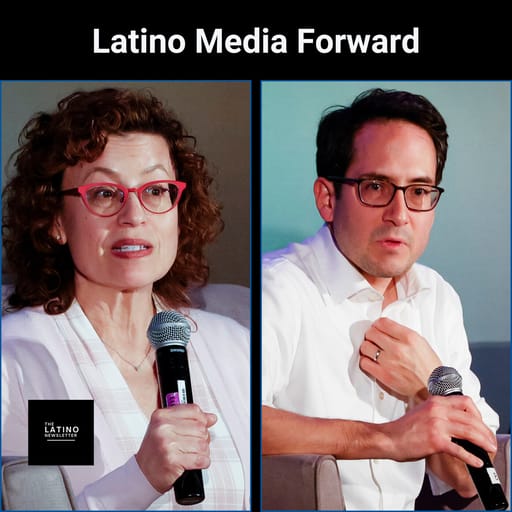
Transcript 0:00 Hey, it's Julio Ricardo Varela of the Latino Newsletter Podcast. And no, this is not season two. We're actually working very hard to make season two happen. Stay tuned for those announcements very, very soon. 0:14 What I'm sharing right now is a bonus episode because on February nineteenth, I got to host a conversation with Commissioner Ana Gomez of the Federal Communications Commission and Commissioner Alvaro Bedoya of the Federal Trade Commission. 0:31 It was during the Night Media Forum in Miami, February nineteenth, so it was a couple of weeks ago, and it was a great late-night conversation. It was prime time. The crowd was awesome. 0:45 I'm just very thankful for the commissioners for being on stage and talking about Latino media, and the conversation was amazing. And we talked a little bit at the start about what's going on in Washington, D.C. 0:59 So what you're hearing is an edited version of that live conversation. I was able to edit the track and produce it. Did my very best. Hope you like it. Anyway, so here it is. 1:14 From the Night Media Forum, my conversation with two federal commissioners, Ana Gomez and Alvaro Bedoya. So let's take it to Miami on February nineteenth. Late Night Snacks! Late Night Snacks! 1:30 I'm your host, Julio Ricardo Varela, and I have two wonderful guests with me today, tonight, here in Miami. 1:37 Guest number one, say who you are and also if you can give me your favorite, I don't know, I'm not-- I don't want to stereotype this, rock en español song or any Spanish language song that you love. 1:47 Something-- and if, if they played it right now with this playlist- Yeah. -you, Commissioner Gomez, would get up and be like, "Let's go." So introduce yourself. 1:55 Wait, I, I wish I'd had this question in advance so I could think about it. [laughs] I did not give this to your advance team. Bueno. Buenas noches todos. 2:02 Yo soy la Comisionada Ana Gómez de la Feder- uh, Comisión Federal de Comunicaciones. Muchas gracias por estar aquí. Do you have a favorite song? Well, my favorite song in Spanish is Osito de Lana. Osito de Lana. 2:15 Osito de Lana. It's the first song I learned on the guitar. Nice. And it's about- You play guitar. Not well. Okay. It's about a little teddy bear. I love it. And- All right. All right. 2:24 And then my second guest over here, if you want to introduce yourself. Look at that. You see? I like it. This was not planned. I love it. Give it up to the crew in the back. This is what happens here in Miami. 2:35 All right, they're gonna clean you up. So, Julio, now that I know what's up, my favorite rock en español song- Okay. You're not gonna introduce yourself first? No, man. Okay. 2:42 My favorite, my favorite rock en español song is Baile Inolvidable by Bad Bunny, which is not a rad rock song, but if you-- but I hear that you play this stuff in the background when- I heard he's really popular. 2:53 [laughs] All right, but while, while they look for- I can play- De-de-deví tirar my photo. My phone. There we go. There we go. Okay. Catherine is like- Can you do the- -his dreams realized right now. 3:03 Commissioner, I'm, I'm not gonna put you on the spot. Okay. But do you, do, do you know, can you perrear or do you know how to- No. No, I do not. I'm just checking. I'm a lot older than that. 3:11 [laughs] I don't think I have ever. Also, I-- there's a lot of words that he says that I don't understand. Okay. I'm not gonna repeat them. [laughs] So your na-- you're Commissioner Alvaro Bedoya. 3:20 I'm Commissioner Alvaro Bedoya. I'm at the Federal Trade Commission, uh, uh, right now. All right. Well... [laughs] [applause] All right, ladies and gentlemen, this has been Late Night Snacks, and we just, you know... 3:34 Okay, what an interesting transition because my first question to the both of you, what is going on in Washington, and how do you begin to unpack this as two federal commissioners? 3:46 Who wants to take this easy question before we get into the actual topic? I'm happy to. So the issue, Julio, is that you pump the crowd up real good- Okay. -and everyone's feeling really good. 3:55 You, you just popped the balloon, man. I think it's wise to be circumspect about this, but I think the thing that I've been telling anyone who asks is, your eyes work, your ears work. 4:06 What you see and what you think you see is what you see. What you hear and what you think you hear is what you are in fact hearing. 4:11 And pretending like what you see is not what you see is not gonna help you or anyone around you. Same for what you're hearing. I was born in Peru. 4:18 I was raised in upstate New York, and I would say as someone who is from Peru and is roughly familiar with Peruvian history, I have a special appreciation for what's happening right now, but I will leave it at that. 4:28 All right. Commissioner Gomez? Yeah. I, I absolutely agree with the commissioner. It is... 4:33 It's a very, very concerning time right now in our country, and what's really concerning about it is we're seeing an administration-wide strategy to control what we are hearing, what people hear, what people can say. 4:48 From the Federal Communications pers- Communications Commission's perspective, it is so worrisome the way that they are going after broadcasters, newscasters- Mm. 4:58 -the news, and telling them what they can and cannot tell the American public. They are holding back information when they don't want information to be out there, and then they are insisting that their truth be told. 5:10 It's very worrisome. You know, the freedom of the press is so important. The Fourth Estate is so important to our democracy. 5:17 We don't need regulators like me or like Commissioner Bedoya interfering in editorial decisions. 5:24 It's very dangerous for our country, and, uh, I'm sorry to pop the balloon even further, but it's- No, I wanted to take the Band-Aid off because I'll be honest with you, because you weren't around here, but I-- today, because I'm like, "I'm doing Late Night Snacks," and people are like, "Are you gonna ask the question?" 5:40 Of course I'm gonna ask the question, and I just wanted to make sure I give you the opportunity becauseI don't wanna diminish it, but and what you said, it's like you see what you see. 5:49 And, um, I appreciate the both of you for being here on stage in public to make... you know, to say what you said because it's, it's not what you said. 5:57 You joked about Commissioner Bedoya, you joked about, "I'm here for now." I mean, it's hitting your people. You're humans. So, um, I appreciate it. You w-wanna say anything else? 6:05 No, I was just gonna say it's, it's particularly concerning when the threat is actually the government itself. Mm-hmm. We're supposed to be serving consumers, not in fact making sure that they are kept from information. 6:16 How do we pivot from this? Because now we wanna talk about Latinos in media. I, I don't know how to... It's like is this is where I say, [singing] I don't know where to go with this. I mean, I... 6:27 'Cause I feel like, I feel like it's important to acknowledge it, and I feel I just had to ask the question. I think what we need is a call to action. Yeah. Right? 6:36 We can move on to what we were gonna talk about, which is Latinos in the media, but we cannot stay silent. If we acquiesce to this, it's gonna happen. Yeah. So, you know, stand up, speak up. 6:46 Well, that's just part of why this topic was so near and dear to my heart. And just when I found out that it was on the agenda, and Commissioner Bedoya was like, "Hey, you wanna do it?" 6:56 I'm like, "Hell yeah, I wanna do it," because this is basically what I've been doing my entire career. So you both have a really interesting... Is it a hypothesis or theory or about, like, Latinos in media? 7:07 Because when you pitched it to me, I was like, it was nerdy, but I was really intrigued. [laughs] So- Sure... so do you wanna, do you wanna nerd it? Now, now let's crank it up to the let's nerd it up a little bit. Okay. 7:19 So, so basically I wrote Julio probably at, like, ten PM or something, being like, "Julio, you need to come talk to us about this audience measurement issue." 7:27 I know that that's not the word you wanna hear at nine thirty- I'm like, "That sounds really interesting." So here's, here's the deal, basically. So, so about... Was it two years ago? 7:35 We came, we did a round table with this amazing nonprofit called We Count. 7:39 Um, and they work with a lot of day laborers, construction workers in Miami and Homestead, a lot of the folks that build these amazing buildings we're in. 7:48 But we had a side meeting with Univision, and, um, we literally just wanted to know what was on their mind. And they said, "Hey, guys, we have a problem, which is, you know, we put all this work into our content. 7:58 We really put out there top flight work, content, art, music, et cetera, what have you." And they said, "But every time we go to sell our ads, we have to sell them at a discount. Why? 8:10 Because all of our audiences are undercounted by the folks who measure them at Nielsen, right?" 8:17 And so we heard that, and, and, you know, when you meet with an, an FTC speaker, market participant, there's all these jargony words, right? 8:24 You meet a market participant, you're always like, in the back of your head, you're like, "Okay, that's you," right? But what if I go to a... 8:31 You know, Univision is a c- is a conglomerate, right, that has been, uh, frankly working very hard to address the full diversity of Latinos in this country, and we're not just a bunch of liberals living in cities. 8:41 We are also conservative, and we live in rural areas. We live all across the country. Univision has been catering very hard, working very hard to try to speak to everyone in our community. 8:49 So then I spoke to a friend who many of you may know, Stephanie Valencia. 8:53 And Stephanie actually is one of the owners of what used to be known as Radio Mambi here in Miami, now I think it's Once Treinta or something like that. Once Treinta, and also it's... 9:00 Is Stephanie's co-founder of Equis Search? Yes. Equis, Equis Labs. Yeah. And I was talking to her and she said, "You know, I have the exact same problem." 9:08 And she's in radio, and she operates, you know, a much smaller local footprint set of radio stations. I think it's seventeen. 9:15 And so we started talking to Univision, Entravision, radio stations X, Y, Z, and every single one said, "Our folks are undercounted, and when we sell our ads, we literally sell them at a discount to our English language competitors." 9:28 And so I had met Commissioner Gomez at a White House event. Was it for Hispanic Heritage Month? Hispanic Heritage Month. Oh, what a surprise. Those things actually produce- What a surprise... useful things. Yes. 9:37 [laughs] Uh, uh, and, uh- Didn't know that Latinos met each other at Hispanic Heritage Month at the White House. It is okay. It is okay. Wow. It's okay to be like, "I have heritage. I celebrate it." 9:47 Um, and so, and, and, and we sat down for coffee, and obviously as a federal communication, this was a core part of the work that she did- Of course... together with Harsha and Dina in her office. 9:58 And so we started meeting with a bunch of folks to try to figure out what the hell was going on. And so that's why we're here in Miami. We had a roundtable earlier. Commissioner Gomez, you can... 10:06 Because this, this is the origin story. Yes. And so what, so how- Yeah... what do you think about this hypothesis- Yeah... or what, what you found out? Well, I agree that we met at the Hispanic Heritage Month reception. 10:16 [laughs] That's probably in finance. I mean, come on. Um, no. Commissioner Bedoya and I have since actually become very close collaborators, particularly on this issue. Yeah. 10:25 I mean, if you look at the country, twenty percent of the country is Latino. Twenty five percent is, uh, under eighteen is Latino. Yep. 10:33 So it's this enormous market that should be an opportunity for anyone that wants to sell a product, show a product, put it over the radio, and yet we're seeing so little Latino content. 10:45 And it led us to have this discussion of what... where is the market failure here? What is happening here that's leading to this lack of representation in programming, in talent- Mm... 10:55 in the behind-the-scenes and news direction? And one of the things that has really fascinated Commissioner Bedoya is this issue of audience measurement. I know. It gets back to the audience measurement tool. 11:05 It's like, it's like, it's like, "Hey, I got, I got graphs." Say it in as many times as possible. I got charts and graphs and data points. I love it. Yeah. So- But it is... 11:15 There's clearly some kind of an issue here if you're not getting the funding in order to sell to this massive market. Yeah. And there's lots of issues. 11:23 It's not just audience measurement that, but that is, that is one of the ones that we have discovered that we can really dig into and figure out where's the failure here. We live in these amazing technological times. 11:34 It shouldn't be this hard. Yeah. 11:36 And, you know, I have a couple of questions to follow up, but one of the things that I wrote down when you talked about this, and I wrote this down, and you talk about the obstacles and the failures, but this is how I feel. 11:48 I feel as if we hear about Latino economic power. Yeah. We hear about the numbers. I'm tired of talking about the numbers, right? We're in Miami. Like, it's a Latin American city. It's cool. 12:00 It's okay to say that, y'all.It's, it's cool, right? Right. Right? But we don't have power. We say there's economic power, but we don't have actual power. So why do you think we don't have actual power? 12:12 Because I look at the situation and say, like, there's so many of us, we could figure it out. You know what I mean? As a community, we can just... Okay, we'll just do it ourselves. Why are we not there yet? 12:23 Why don't we have power in this country? As I say this to two federal commissioners, I'm like [laughing] No, I mean- No, it's not- Um, it is absolutely true that what we have is a shadow of what we should have. 12:41 I, to be very honest with you, don't know what the answer to that question is. There's a, there's a bunch of half answers. Right. The half answers are our population is disproportionately small. 12:50 It's disproportionately first or second generation, depending on how you treat that, right? Mm-hmm. You're either an immigrant or first generation. 12:56 And so one would hope that in half a generation, in a generation, you're gonna start to see more of that. I actually think it's very helpful to actually come back to what we're talking about with Latino media. 13:06 So let's talk about mystery number two. I talked about mystery number one, audience measurement. I will not say that word for three minutes, okay? All right, we're gonna time him. Okay. 13:14 So let's do mystery number two, right? Yeah. So let's talk about music. Latinos are killing it in music. Bad Bunny, Peso Pluma, Kali Uchis, Karol G, Takisha, Shakira, right? There are... 13:26 Depending on the year, Bad Bunny beats Taylor Swift on Spotify. Peso Pluma beats her on top st- uh, tops her streams on YouTube. Yeah. You know, Beyoncé and Taylor Swift sometimes, you know, t- Yeah. 13:37 Like, our folks are consistently at the top. Mm. And the crazy thing about all those performers, except for Shakira and a little bit Karol G, is they all sing in Spanish, right? 13:47 And yet they are national level musicians that are consistently at the top, right? Hold that thought and then think about film and television, specifically television, right? 13:56 Can you think of a show that has a Latino lead in it, positively portrayed Latino lead? Maybe The Lincoln Lawyer? That's literally what Ana said, what Commissioner Gomez said. Commissioner, what- Great show. 14:07 And I was like, "I don't know that. I need to watch that," right? So you haven't watched The Lincoln Lawyer? The other one might... Now I have. I watched it. Now I have. Oh, okay, good. All right, good. 14:13 Thank you, Commissioner Gomez, for giving a good recommendation. Then there was, uh, you thought of only- Jane the Virgin. Jane the Virgin in the building. And then there's, like, a long pause. 14:21 Jane the Virgin- Not, not- But it's not anymore. Not anymore. Right? There was This Fool for a hot minute, which is amazing. Wh-what do we got? I'm hearing... What, what- What's that? [laughing] Modern Family. 14:32 Modern Family. Yes. Excellent. Good. Which one's that? Mo- But is it at the same level of what's happening in music, right? Excellent. But let me ask you the question. But is it Bad Bunny? 14:42 Is that what you're- But is it Bad Bunny? That's how he's trying- And the answer is no. Yeah. And so what is going on, right? And all those people we've been talking about are performing in television in English, right? 14:54 And so how wild is it that the American public will vote with their clicks to the top of the charts, not just Latino artists, but artists who are performing in Spanish, and not, like, easy Spanish. 15:04 Like, if you've listened to any of these albums, like, it's like there's a lot of like, you, you can't really understand all of it. Yeah. They love the music, right? Yeah. 15:12 And, and we-- and so what is happening there is the second question. All right. Yeah. Okay. So, Commissioner Gomez- Please... to answer that question, so why don't we have power as a community? 15:21 I'm making that ass- I'm, I'm making that assumption. I'm making the claim that we don't have power- Yeah... in this country. And I, I can't answer that. 15:26 There is so much complexity to this issue, that the communities will go where they see themselves. And so we have major over-representation on YouTube. Mm. 15:36 Significantly higher YouTube viewership by Latinos than by their white counterparts- Right... for example. Same thing with TikTok. There, it, we actually have a viewership higher than, than white people. Why? 15:50 Because that's where the content is. So again, where's the business decision here that isn't taking into account this, this issue? And I would like to point out- Yeah... 16:00 just 'cause I like this story, so I like to tell it- Yeah... even though it's really not related to this issue. Let's go. Uh, so, you know, I grew up in Colombia- Yeah... and love me a telenovela. 16:11 And [laughing] I- Is that a reveal? Like, Commissioner Gomez loves a good- Yes... tele- telenovela. Yes. Good. I never really thought I would see Colombian content or Colombian-like content- Yeah... 16:22 in m- in just a network television. And saw Betty La Fea, a good Colombian- Mm... telenovela. Then it got remade in Mexico, and it became La Fea Más Bella, which was okay. Not quite as good- [laughing]... 16:35 I thought as Betty La Fea. Sorry to my Mexican friends. And then it became Ugly Betty- Yeah... which was a huge hit in this country. 16:44 So we do have examples of good, wholesome programming that succeeds, and yet we don't really have as much content as we think we should have. 16:53 We don't have as much representation either in front of the camera or behind the camera. Yeah. I, I'm struck by the fact that you both couldn't fully answer the question. 17:02 I have a part answer that I didn't give, but, uh, uh, go ahead. Uh, can I give you some- Yeah. Yeah. Yeah, yeah. 17:06 Um, since you haven't talked about measurement tools, can I give you my da- Audience measurement, you wanna talk about? Yeah. So this is the compromise. Easy. You passed the three-minute limit. Okay. 17:14 But I, this is- I can, I can do it if you want me to. All right. This is how much of a nerd I am. Okay. Okay? I actually have this screen grab from Pew Research, like, on my desk every day. Yeah. Okay? Yeah. 17:26 Let's go, Pew Research. You know how much I love you. Pew Research. I really do. Pew Research? Yeah. That's awesome. Okay. No, no, seriously. They... 17:34 People at Pew Research know that I, I am like a Pew Research, like, walking advertisement. That's a, that's a good- I, like, I could do a music video about it. 17:41 But listen, it's how Hispanics got their news, and if you just give me, like, a minute to break down this data because I think this starts giving some context to why this big question is hard to answer. 17:51 So Latinos, how do they mostly get their news? And this is from twenty twenty-four. Mostly in English, all Latinos, fifty-four percent. Mostly in Spanish, all Latinos, twenty-one percent. 18:01 Both languages, twenty-three percent. So that's-All Latinos, right? When you break it down by immigrant, like first generation, that fifty-four percent of all Latinos in English goes down to twenty-six percent. 18:10 The twenty-one percent from Spanish goes up to forty-one percent, and the bilingual stays at thirty-one percent. 18:17 US-born, US-born Latinos, eighty-one percent, eighty-one percent of US-born Latinos consume their news in English. 18:24 Two percent US-born individuals get their news in, in, um, two percent in Spanish, and sixteen percent get it bilingually. When you say how they prefer to get their news, same numbers. 18:35 So what you have is a divide linguistically, and the problem with the obstacles is now you have six markets. You have six markets, right? We can look at the media landscape. Let's have a quiz. 18:46 Give me your Spanish language broadcasters. Who do we know? Univision, Telemundo, right? Everyone knows that, right? Right. Their legacy corporate media. 18:53 Give me your Latino English-only networks or outlets that serve eighty-one percent of US-born Latinos who prefer their, their content in English. And I'm not trying to knock Spanish. 19:04 I'm just trying to make a point here because when I make this point, sometimes people go like, "You hate Spanish." Like, no, no. Yo no odio el español. It's, it's who I am, right? 19:13 But name me, name me a network, eighty-one percent that's, that's Latino-centric. Eighty-one percent of Latinos get their news. And basically, the issue is that the folks who try fail. 19:21 So didn't Fusion try this, you know, and failed and- Well, let's talk about the Fusion thing if, if you know. If you remember Fusion- I, I don't remember. 19:28 I just- So, so Fusion came out in twenty thirteen, very Latino-centric. Yeah. And then focus groups happened with ABC and Disney. Yeah. 19:36 And then all of a sudden it went from Latino-centric to young people of color, which again is not a bad business decision. Right. Right. Right. But it stopped being that English language outlet. 19:49 I'm just curious as to what you think about sort of that complexity of language and culture and generation as being part of an obstacle that we have never really addressed. Thoughts, commissioners? 20:00 So when I talk to folks who know a little bit about the music industry versus the media industry- Yeah...right? 20:07 What they'll say to me is, and these are folks from LA, folks who know a little bit of their stuff, they'll say, "You know, what do you need to make it in music? Like, you basically need to 20:15 get on YouTube or Spotify, right? That's all you need. You need a, like a recording studio. You can do it in your bedroom- Yeah. -you can do it in your garage. Get on there, right? And you go direct to your audience." 20:23 Now are there powerful market actors that are inter-intermediaries? Yes. That could limit in some way? Maybe, right? Yeah. 20:30 But whereas with a news show, whereas w- you know, with a entertainment, with a TV show, there is so much capital, there is so much, so many intermediaries. 20:39 There's the talent agencies, there's the studios, you know, there is the whole distribution network. 20:45 There's so many hoops you have to jump through, and that's why I-- that's my preliminary answer to that second mystery question of why the heck is there... 20:52 Are we crushing it on music, but basically not there when it comes to content and news? But when you're ready, I'll come back to the power question. I've, I've- I, okay. We have time. 21:01 I don't know what the rules are with late-night snacks, but I'm ready [laughing]. Commissioner Gomez, your thoughts. I think of this as distinct sectors of our- Uh, y- Like media consumption. 21:11 You know, remember when we used to say that, that Hispanics and Latinos are not a monolith? You know, do you know what? You know what? I have yet to say that phrase in twenty twenty-five, and I'm so damn proud. 21:23 [laughing] Like, the, the lessons of twenty twenty-four is that- Yeah...that phrase will never get used ever in mainstream media again. I- We've passed that. Yeah. 21:33 So I'm glad that you're, you're like- [laughing] "I, I have not said it." [laughing] And you know, but it shows our complexity. So say more, please. 21:39 My point though is if you break down any part of the viewing public- Yeah...you're also gonna have breakdowns like these, and y-yet somehow we figure out how to market to those particular segments. 21:48 So yes, I think that's a complexity that you need to look at. There's Spanish speakers, there's English speakers, there's Spanglish speakers. That's what we heard this morning. 21:56 Oh, we, we visited CBS, the local CBS affiliate this morning, and they were talking to us about the fact that, in fact, what they're starting to do is when they s-- with social media- Yeah...segments, they're doing them in English and Spanish because a lot of the viewership is now on streaming. 22:11 So they're seeing it as, as a market imperative, certainly here, which makes a lot of sense 'cause we're in Miami. 22:16 But bottom line, I think you can break down any, any market segment into, into subsegments and still will find Latinos less represented. Yeah. But outside of Miami- Mm. 22:27 When we look at, because you're mentioning, you know, when you look at the demographic changes, high P research, I do my work. The fastest growing states in this country for Latinos are North Dakota- And Vermont. 22:38 I just heard that today. Vermont? Yes. Vermont. You know, Idaho. Yeah. So we're, we're now in, we're now national, right? And it feels like we're just, just getting started, you know? 22:50 So I- And so this, this is what I wanted to get back to- Yeah...which is if you look at people my age, right, and look at the question of conventional who is in power, great. It's not, it's not a great answer. 23:01 We're coming up short. What I find really, really exciting is when you look at the next generation and you look at music, you look at poetry, you look at literature, and these folks do not give... They d-they don't care. 23:18 Un carajo. Uh, uh, they are defiant, they are unapologetic. Yeah, yeah. 23:21 You look at, you know, when I was growing up, the thing that you did was like, "Oh, you know, I went through such hardship," and I-- you tell your story and, and that's how you get the scholarships and you get into college. 23:33 These guys are like, "I don't care. I don't need to explain myself to you. I don't need to apologize. I don't need to tell you, 'Pobrecito, I, I went through this, that.'" Uh, examples. 23:43 Carla Cornejo Villavicencio, "The Undocumented Americans," the guy who wrote Solito, who's also a brilliant poet, the guy who wrote, um, whose name is escaping me, Mexican American Disambiguation. Citizen Illegal. 23:53 He's an American, uh, amazing, uh, Chicago poet. 23:56 Over here in music, Bad Bunny, all these guys who could in a heartbeat, like, do a collab with, you know, Katy Perry or whoever, and Bad Bunny says, "No, I will literally only work with artists from the island," right? 24:07 "Who you've never heard of, but I'm gonna use my power and my money to lift these people up." So you've heard of El Gran Combo, even though you've never heard of him before, right? 24:15 Although a lot of us probably have heard of him. Like, all these other local artists. And so that is what's happening in that generation. Yeah. 24:21 And you look at then the activists, the Mijente, United We Dreams, et cetera, that is the attitude they bring to the table that I think is really exciting. 24:29 And so I, yeah, I, I think this, you know, my generation, you got some folks, right? It's the next generation that doesn't feel like they need to play by these, uh, model immigrant rules, right? Mm. 24:40 Of, you know, I am, I am good. I've suffered, and that's why you should let me be part of your club. It's like, "No, I got a club. If you wanna be into it, you can come talk to me, but I don't really care." 24:49 I created the club- Right?...now you get to decide the rules. Commissioner Gomez, I, I mean, do you feel because we still are sort of a... evolving population that we are seeing? 25:01 Like, to, to Commissioner Bedolla's point or your thoughts about that? I mean, I love, I love the fact that you're seeing these artists that are pulling up others. That is so very important. 25:11 And honestly, that is how we end up with biases one way or anan- another, because a lot of what if you really dig into why it is that we don't see representation in Hollywood, for example- Mm.... 25:23 part of it is where's your pipeline coming from? Mm. Is there a particular school? Are there particular people? Yeah. 25:29 I mean, why is it always the same names in Hollywood that, that, that seem to be getting all the starring roles? 25:35 So it's important for us to support up and coming artists, and it's important for us to be able to identify new talent, so you raise a very good point. And he loves Bad Bunny. I do. I know. 25:45 I, I feel like- I, look- I feel like you're gonna- I stopped listening and-... charts and like- The last album I stopped, and then this album is just too good. 25:52 One of the things that you're seeing to break the obstacles- Yes... to get to power is that the people in the position where they can say- Yes... "Get out of the way. 26:00 I'm in charge, and I get to decide what we're gonna do artistically. And guess what? It's gonna be a commercial success because I am who I am." Right. And I think that's really important. 26:11 But to the point that you're, you're saying, 'cause I wanna get back to... Audience measurement? Oh f- [laughing] I totally walked into that. You got it, man. 26:20 I'm here f- if you want it, I got- Man, that was, that was well played... like four items, five items maybe. That was well played, Commissioner, but, um, you're allowed to say audience members. 26:28 You know, we've been ten minutes. But let's talk about the outlets that took the risk that said- Mm... 26:36 "We're in," whether it's a show, whether it's journalism, whatever, and maybe it started out so, like, "Woo, this is great." 26:44 And I-- You know, we could talk about the Hulu series, Commissioner Bedolla, because I- It's really good. Did you watch it? Yeah. I love it. The, that full- Yeah. This Fool? This Fool. Yeah, yeah, yeah. I love it. 26:51 Let's talk about... First of all, let's talk about that feeling of when you saw something, Commissioner Gomez, in the last couple years to be like, "Oh, this speaks to me- Mm... and this might have hope." 27:01 Do you have any examples of things that you've seen or that have been like, "Okay, we're on the right path"? Or do you feel like there's never been anything in the last couple years that are reflecting what our power? 27:12 No, no, no. There's so much. There is- So give me a couple examples... there is quality content. We talked about Jane the Virgin. Yeah. We talked about The Lincoln Lawyer, which I did like. Yeah. 27:19 But something recent that had a chance to get- Oh, that didn't make it? Gosh, that I, that I even saw? Right. 27:26 Do you- I, I, I'm one of those people who's a late adopter because if it's gonna get canceled, I don't wanna watch it. Oh no, really? Yes. But I watched This Fool because you made me. All right. 27:34 So let's talk about This Fool. I just wanted to set up... I didn't wanna like be like, "Hey, let's talk about This Fool," but if you're like, "I watched This Fool," let's go. Yeah. You, you okay. 27:40 Let's talk about This Fool, the perfect example, I think. No, you're the, you're- All right. Okay... Commissioner Pesce- No, no... or This Fool. This Fool wants to talk about This Fool, sorry. Yes. [laughing] It's true. 27:49 It's true. Show of hands, who has seen the show in the audience? Hulu, This Fool. Thank you. That is one person. One person. [laughing] Wow. Thank you. Thank you. Wow. 28:01 So- That, that answers a lot- That answers- Like, it, it, so see? So okay- One person... let me, let me, let me contrast why, why I'm so excited about it. 28:09 So I watched Jane the Virgin, and the thing that bothered me about Jane the Virgin is you'd listen to it and you'd be like, they literally took the English and just Google translated it. Okay. 28:18 And, and you'd be like, "That is not a sentence that makes sense in Spanish." That is, if someone wrote that sentence in English and just translated it. 28:24 Then the other thing is everyone was more or less a native Spanish speaker, but then, like, the accents wouldn't make sense. Like they-- I think they're supposed to be from Col- Colombia, right? 28:32 But then you'd be like, "That lady's Chilean." [laughing] And like, this guy's clearly Mexican American, and like, none of it makes sense. Yeah. And, and what bothers me is, like, we are twenty percent of the population. 28:43 We are sixty million people, and if you set a show, my wife's from Louisiana, in Louisiana, are you gonna put a guy with a, with like a sou- a, an accent from like Southie in Boston, you know, like, in the show and, and everyone's gonna be like, "That's normal. 28:55 He sounds like he's from Boston"? [laughing] No. You'd be like, "That's ridiculous. Why does he sound like he's from, you know, anywhere other than the place he's supposed to be from?" 29:04 And yet we're, we're so inured, we're like, "Oh my God, they're speaking our language. It's awesome." And it was, it was a good show. Like, I watched that show, but it's like why... 29:11 Uh, the, the other terrible example that drives me insane is Breaking Bad. That amazing actor, he is a stage actor. He is a trained, classically trained actor, Gus Fring. Uh, what's his name, the actor's name? 29:22 Uh, Giancarlo- He is a gentleman and a scholar, and I love the man. Clearly does not speak Spanish, right? 29:28 [laughing] And so, like, he speaks like a guy who's trying to sound like he is a native Spanish speaker, but very much is not, right? And so, like, Breaking Bad, prestige television, right? Yeah. 29:39 You can't even find someone who actually speaks the language like it's supposed to s- to sound. In California. In California. [laughing] That's good. The beauty of This Fool is that it makes sense. Yeah. 29:50 Everyone sounds like they're supposed to sound. Everyone- It takes place in East LA. Yes. It- And it's a four- it's a third- Right... fourth generation- Yes... Mexican Am- family, right? Yes. 29:58 It felt like you were in Boyle Heights. Yes. Right? No, that's exactly right. I mean, and a lot of the shows that we've been talking about where we know there's one actor- Yeah... that's not really a Latino show. 30:09 There just happens to be a Latino- Yeah, Lincoln Law- you're right... in Only Murders in the Building. Selena Gomez. Right. Selena Gomez, and she's awesome, and she's a Gomez. Always a good thing. 30:18 [laughing] It's the richness of having a, a, it built around a Latino community. Yeah. Um, a Latino family. 30:27 Uh, you know, that is, is even smaller percentage than what we see where you have a showrunner or you have, you know, one- And I think the part of the... This is a perfect example of the content. 30:37 The point being about This Fool is- Yeah... and even something like Gentefied, they speak to the growing population that's younger- Yeah... 30:47 you know, under 30, that speaks, that lives in this bicultural world, that's not asking for permission, what you're saying, that's, you know, trying to create their own lanes.But they don't get a chance. 30:56 It-- So this fool gets sort of this... Like, it resonated with... I, I didn't meet a lot of people in my circles who were like, "Wow, this is like the... Like, I don't like this show." 31:04 It's like this is, this is a funny show and just never had a chance. So that's where it comes back to the issue of power and respect, wherein the fact that we don't control it yet, right? 31:15 We don't have, as a community, the means to, to be able to do our own thing, and we're still having this conversat-- I've been having this conversation since, like, nineteen eighty-six. Mm. Right? 31:26 And here we are in twenty twenty-five, and the same issues about, you know, the sweeping demographics. Like, we're still having that conversation. So is it structural? Is it institutional? Is it cultural? 31:37 Is it inward in ourselves- Mm. -because we don't get along with each other, right? So I think there's a lot there. Last thing I'll say is what gives me hope. 31:45 I just go back to the young, tr- specifically for Latinos, the young people, right, who don't feel like they need to prove anything to anybody and who are making amazing art, amazing music, writing amazing books, amazing poetry, and that, that's what gives me sustenance. 31:58 I, I think on that note, I don't think we have any final thoughts after that. Yeah. Go. Um, that was... So I just wanna thank you all for the respect and for the, the time and space to have this conversation. 32:10 I think part of as we navigate through all this, we can't lose focus on, you know, this community and, and these two leaders who represent the Latino community. 32:20 I'm just very thankful that you took the time to be with us at night after a very busy schedule. I've, I saw it, and so if you can just one last time give it up for the two federal commissioners. 32:32 [audience clapping] And thank you very much. Late Night Snacks. I just want to thank [upbeat music] Commissioners Gomez and Bedolla for being on stage during that live event. 32:47 Special thanks to everyone at the Knight Media Forum for hosting the event. The vibe was great. The people were great. The audience was great. The crew was great. 32:58 I thought the conversation was a really important conversation. So if you like what you heard, rate and review us on Spotify, Apple Podcasts. We're also on several social media networks, right? 33:10 We're Latin Newsletter on Twitter/X. We're still there. Blue Sky, we're also Latin Newsletter at Blue Sky App. And actually, Blue Sky has become our largest social audience, which is incredible. 33:22 At the same time, you can follow us on Facebook, The Latino Newsletter, LinkedIn, YouTube, Threads, TikTok. I think that covered everything. 33:30 And if you wanna subscribe to our daily newsletter, you can subscribe on LinkedIn or you can subscribe at thelatinonewsletter.org. 33:38 As for season two, we are very close to trying to get funding to secure season two so my producer, Joaquin Kotler, and I can continue to deliver weekly conversations. 33:51 We've gotten such amazing responses from season one, so we think we have something here, so we're gonna keep going. 33:58 In the meantime, follow us at thelatinonewsletter.org, and we will be back as soon as we can be back with season two. So let me toss out the credits. 34:08 This bonus episode of The Latino Newsletter podcast was produced and edited by me, Julio Ricardo Varela, with the Knight Media Forum, who recorded all that, and with the crew. 34:19 So thank you for the audio, Knight Media Forum. The music you heard is by Cast of Characters via Soundstripe. Julio Ricardo Varela, The Latino Newsletter podcast. We will be back soon.