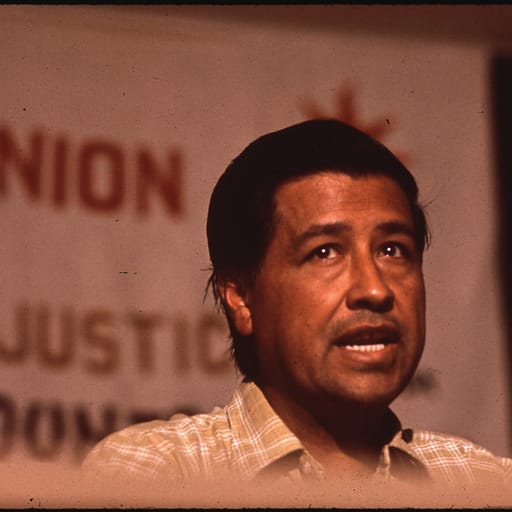
Transcript 0:00 [upbeat music] Welcome to the Latino Newsletter Podcast. I'm your host, Michelle Zacarias, and I just wanna share a quick trigger warning for discussions of sexual violence on today's special episode. 0:14 This week has been a lot to process, especially for victims of sexual abuse and violence. Dolores Huerta spoke out about being raped by labor rights activist Cesar Chavez. 0:27 Dolores was assaulted twice by Chavez during her time organizing with the United Farm Workers, ultimately resulting in the birth of two children. Dolores Huerta is a feminist icon and leader of the labor rights movement. 0:41 Her work leaves a lasting legacy that can never be forgotten or minimized. I met Dolores in person at an event in Sacramento in 2023, and she was very small in stature, but she made up for it in presence. 0:56 Even in her 90s, Dolores was full of fire, and she had an energy that controlled the entire room. 1:02 When I met her, I shared with her that I was from Chicago, and her eyes lit up as she told me, "I love Chicago organizers." At the end of the night, I watched her help the staff clean up glasses and utensils. 1:15 She truly was a woman of the people. They always say, "Never meet your heroes", but I could not have been more in awe of her. 1:23 Dolores was also one of the first featured guests on the Latino Newsletter Podcast after I became the host, and she was a early supporter of my work and was extremely kind and generous, and so I'm very grateful to have had her share her experiences and knowledge with us. 1:41 I stand in solidarity with Dolores Huerta and the other survivors who experienced sexual abuse at the hands of Cesar Chavez. 1:49 Today, I'm gonna be joined by Julio Ricardo Varela, our Latino Newsletter founder and previous host of the podcast, to discuss just the public response and reaction to Dolores' announcement. 2:01 [upbeat music] Well, Julio, thank you for being here today for this special episode of the Latino Newsletter Podcast. Um, yeah, let's address the elephant in the room. [sighs] I mean, can I ask you 2:18 when it broke, like when did you find out, and what was going through your mind? I actually woke up to the news. Um, 2:26 and it's so weird because so much bad news has happened over the course of, you know, however long, um, that I've almost become accustomed to it. 2:35 But I think this felt very personal for a lot of people, especially in the Latino community and the Chicano community and the labor organizing space. 2:45 Dolores Huerta is a, an icon and a, and a legend and a hero to a lot of people, and so it was really heartbreaking and devastating to read her statement and her testimony. Yeah. 2:59 And then I'm sure also there's a component of it with a lot of people who were reconciling with the gravity of this accusation against Cesar Chavez, right? 3:10 So I, I think for me it was just a lot of processing, a lot of taking in the information, um, and, and also seeing the public response to it, which has been interesting as well. 3:23 Um, what, what have you seen, I guess, on your end of the country? Uh, I, I will say, you know, our... We have Latino algorithms, right? So, so we see a lot of statements and 3:38 solidarity, and it's been overwhelmingly, you know, "I stand with the survivors," and I think that's... Look, that is the right way to approach this. 3:53 And you see it from a, a span, like when I, when I published the summary, uh, on the Latino Newsletter on Wednesday, you know, we were talking as a newsroom, like, "How are we gonna do this?" 4:03 And, and I could've published another like 10 more statements. You know what I mean? 4:08 Like, they were coming, and like they were literally, as I was clicking publish, it's like, "Here's another one, and here's another one, and here's Gustavo Arellano's column, and here's another one." 4:18 And then, you know, on, on Thursday you have Latino USA with Mariana Jose having Dolores on, and like here's Thursday morning, and now we're... 4:30 And California's changing the name of Cesar Chavez Day, and we're gonna go in the process of changing it to Farm Workers Day. And there's so much that this is a gut punch to the community. 4:42 So ma- I mean, I've gotten personal messages from people saying, you know, "My, my grandparents marched with Cesar and Dolores. Like, my parents were there." 4:53 Um, you start seeing people posting stories that, you know, they're becoming more public about it because I do feel that, you know, this has opened up a necessary conversation that I think maybe... Let's just be honest. 5:11 Like, there were-- there's a lot of people I've talked to who are like, "This should've been discussed a long time ago, but here we are," right? So that's kinda where I'm at, Michelle. 5:24 And so when I try to look at this from my perspective of what can we bring as journalists, as voices, I tend to wanna elevate what, what the survivors are saying, right? 5:39 So, and even in the piece that I wrote for MS now, I intentionally started with Dolores 'cause I shared a stage with her last November. And, you know, Dolores Huerta, 95 gonna be 96, still, 5:56 man, still leading with bravery, still showing us how it's done with pain.Still putting the movement ahead of her a- and saying, like, "I have personal pain, but there's a bigger goal here." So there's a lot to process. 6:13 And I know you have such a, a really lovely relationship with Dolores. Um, I was really touched by your statement of solidarity that you, you, you took the time to, to share that. 6:26 And you told me, you know, "This is how I wanna lead this," and I said, "Go for it." And so what made you feel like, "I had to do this." And, and, and what have been people-- what have others been telling you? 6:38 I mean, you're on the West Coast. I'm a little bit, you know, here I am with my Boston hat on the East Coast, so. I think obviously there is, like, an interpersonal kind of dynamic here. 6:49 I met Dolores in, uh, twenty twenty-three in person for the first time, and she was just lovely and, and kind and, and gracious, and everything that everyone says she is, right? 7:00 Um, I, I said in my statement, like, they always say, "Don't meet your heroes," but, like, I have nothing but awe and admiration for her. And she was in her nineties at the time. 7:10 I think she's nearing ninety-six now, but she was in her nineties. Yeah. She was running around helping the staff clean up glasses and utensils at the end of the night. She was definitely, like, for the people. 7:21 Um, and she was such an inspiration to so many of us, and I think that's the part that's so difficult to reconcile with. Not that I think of her differently or that I think less of her. 7:34 It's just that to acknowledge that someone of her stature could have felt 7:43 like she needed to sit on this information for so long for fear of not being taken seriously or being stigmatized or it being a detriment to the movement. 7:54 And I think that's a, a reality that a lot of folks are grappling with and we need to reconcile with, especially on the left, right? 8:02 Because a lot of the immediate reactions I saw online were kinda like these recycled talking points saying like, "Well, meanwhile the right has, you know, a, a pedophile and a criminal in the White House and X, Y, and Z." 8:16 And I'm sorry, but that's a sloppy argument. I don't want to hold myself or my political alignment to the same standards that the right does, right? 8:26 Like, we have problem in organizing spaces and activist spaces, in labor movements of people who do exploit their power and their positions of leadership to enact, uh, gendered violence and harm against women, and we need to hold ourselves to a higher standard. 8:43 Hmm. So I think there's a lot of anger and a lot of, um, concern about how much more of this there is, you know. Because the reality is we have these three testimonies, basically. 8:56 We have Dolores, um, and two other individuals who I think we should name. Mm-hmm. Yeah, Ana Murillo and, and is it, uh, Deborah Rojas, who are both sixty-six, right? Who were, 9:09 I mean- Children when they were- Were children. I wouldn't even say- Yeah... like, were, like, pre-teen. Like, they're children. Like, you can say, like, "Oh, they were teenagers." No, they were kids. 9:18 It's, uh, mind-blowing to me to think about the fact that nobody knew anything, right? 9:23 I don't know if I necessarily buy the fact that we had this huge movement mostly led by women, mostly, uh, you know, uh, women organizers. 9:34 As Dolores even said, like, Cesar Chavez promoted women in the ranks and brought them around to the movements and the campaign. 9:43 So I, you know, I, I think I have a difficult time thinking that nobody was aware of what was happening. And as an former organizer, it make me think proactively, like, what can we do moving forward to prevent- Yeah... 9:57 things like this from happening again? What can we do? I mean, do you wanna get to that? I've already written my MSNBC Now piece that's out there, and I basically said, you know, at one point... 10:08 Because, you know, I felt, I feel like a fool when I was kinda like, "Yo, right wing, stop co-opting Cesar Chavez's immigration positions," like he changed it. 10:18 And I spent a long time in my journalistic career, like, trying to prove that. I had talked to, I talked to college students. I mean, it's all out there. And I knew the complexities going in. I wanna be really clear. 10:29 Like, I, like, there's a lot here that has, it's already been chronicled about his behavior, although not at the level of pedophilia [chuckles] and, like, sexual abuse and rape. 10:42 You know, those are the words that were, you know, Dolores said that. But at the same time, as a young kid in the '70s who didn't see a lot of Brown faces in 10:55 places and saw this man and Dolores, right, sort of teaching us, like, this is how you do it, man, that's... Like, I'm like, "What the hell? What the hell do we do with this?" 11:10 I think we're still at the stage of like, okay, it's out there. There's a lot of reaction. It's like, huh, like [laughs] what do the Michelle Zacharias' of the world, what are they thinking? And how do you push forward? 11:28 Well, you know, there is a huge discrepancy behind some of the original allegations and valid concerns about Cesar Chavez than what we're talking about now, right? Like- Mm-hmm... 11:38 we're talking about violence at the highest level against some of the most vulnerable children, but there were a lot of concerns about Cesar Chavez, including, you know, his anti-undocumented rhetoric and, um, initiatives launching the Illegals campaign, um, with his cousin acting as kind of a contract border patrol. 12:00 Um, and I know that some of his views evolved, and we do always love to see change and evolution.I think leading up to this, right, there are valid and reasonable concerns that were already on the table. 12:15 Nothing that feels as egregious as this, but there was enough of it that we could have sat there and really dissected, right, like the, the complexity of like human beings, and I think that's the problem. 12:28 In activism organizing spaces, we always create these faces of the movement. We always put these people up on the pedestal because we crave that representation. We crave that access. 12:41 And Cesar Chavez was obviously a Brown man, but he was given access in ways that a lot of people around him were not given. Yeah. And because of that, people wanted to root for him. They wanted him in powerful places. 12:54 They wanted him to act as an advocate. Now, my opinion is that movements should never be one person. It should never be one individual. 13:03 We should never put them at the forefront of something, because the core of the work is collectivism, right? It's collective work that everyone contributes. Um, and so at the end of the day, 13:14 the, the, the byproduct of his legacy is really just, uh, the work that was done by numerous labor organizers. It wasn't just the Cesar Chavez of the world, it was the all the people around him- Yeah... 13:28 who made that movement successful. So, you know, I, I think when we ask like, "How can we prevent this?" It's like, well, maybe we need to stop putting people on a pedestal. 13:38 Maybe we need to start interrogating people as human beings and really understand that every person, regardless of how progressive or good they might seem, had the capacity to cause harm. 13:52 I think you, you raise a good point about when you're thirsty or when you're hungry for representation and to be seen, that, 14:01 you know, we, we, we go grab whatever we can grab, like in the sense of like, oh, there is a hero. And you know, I try to look back in the '70s and the '80s when, or in the '90s when, you know... 14:17 Like when I, when I found out, just to say, when I found about that letter where he evolved, where I was kinda like, look, it's pretty clear that, yeah, he got political. 14:25 Like they were saying like, "Hey, yo, you gotta like start talking about, you know, farm workers this way." 14:31 And you know, and it was co-opted by the right, and that's the only reason why I was like, "I need to prove this," right? That was happening at the same time, when you look at the timeline of The New York Times report, 14:44 where there were accusations now of pedophilia. So there's a part of me that's like, okay. You know what I mean? 14:50 It's like I, I think what you're saying is, is really so essential, and this mythology that Gustavo Arellano talked about, and I talked about it in my piece, but this sort of mythology of we need this Latino leader. 15:06 Maybe we don't. Like we actually don't. And the real heroes is what I wrote in my piece are the people like Dolores and, who just said like, "No, I'm gonna... I held this, 15:17 and I'm gonna talk about it, and I'm gonna turn 96 in a couple of weeks. And here it is, and I'm doing..." And this is the part, and this is what I said in my piece, it's like 15:27 I actually think that's such a radical point of community love that even as Dolores reaches her 96th birthday, she's like, "I'm actually doing this because I believe in a greater thing, and you should follow this lead." 15:41 And so I am just in awe of how this incredible woman continues to fight in an age where, you know, American society says that elders get ignored, right? So there's a part of me that's, that's 16:00 really uplifting and hopeful to see so much outpouring of love for- Yeah... someone who shared her pain. And, and, you know, Maria Hinojosa interviewed her on the Latino USA interview, and I recommend everyone 16:15 listen to that interview, 'cause that's the first interview that Dolores gave after she issued her statement in The New York Times piece. And I'm not knocking The New York Times, believe me. Like th- this is... 16:27 I don't want people to misread this. But it does make a difference when, when Dolores is in a place where she's being interviewed by a show [chuckles] from Maria that are like, "We're Latino. We get it." 16:41 And I think that was really clear in the interview. So those are my, my sort of overall thoughts, and, and I don't know where the community goes next. 16:48 I do think there is a reckoning, like the fact that like names are changing and California's changing already the name of like to Farm Workers' Day. So- Yeah... Sabrina Maria Daniels 16:57 published an opinion piece Thursday at the Latino newsletter about her experience of all this. I think there's a lot of people who wanna just share, right? Yeah. No, no, no. So we need to listen. 17:07 And I think, uh, I do wanna kind of circle back quickly to the interview that Dolores gave. 17:12 Um, it was the first interview since all of this news broke, and I, I think it's really important and it's powerful to listen to that testimony, because she talks about really wanting to kind of protect this secret, right, is what she continuously referred to. 17:30 It's a secret at the expense of herself, because she really believed in the work and the movement and the progress that, you know, was being made. 17:40 And even in that interview she says like, we would not have certain rights, migrant workers would not have certain rights if it weren't for X, Y, and Z type of organizing that Cesar was- Right... involved in. 17:52 And I think therein lies a complication, because on one hand, Dolores is a victim and deserves empathy, and on the other hand, she doesn't owe anybody a timeline for why she held onto the secret, why she felt like she couldn't say something publicly.And at the same time, I think it's a testament to the failure of our society that we created an environment that doesn't feel safe for women to come out and speak about these types of instances, um, of rape and sexual violence, right? 18:26 I think it's a testament to the work that we need to do. Um, and there are so many layers of harm there because who knows, maybe if Delores had been able to come out sooner, other folks would have been protected. 18:39 Um, maybe this is something that could have been resolved or addressed while he was still alive. Um, I, I think it-- we c- we can only guess the, the what ifs and what could have been different. But I know that 18:54 the response has been swift, and so what I see is we have the capability to address these issues. We have the capacity to make sure that we implement s- safety for the women and children in these spaces. Hmm. 19:09 And I think it's notable that so many large organizations that had previously been very closely affiliated with, um, the work that Cesar Chavez did have spoken out. 19:20 But I also think that it's worth noting that a lot of them got a heads-up about it, and they knew that this was gonna be huge news and that this was a five-year-long investigation. This wasn't like a silly rumor. 19:32 This was something with validity. 19:34 So having all of that prior information, they also had the ability to prep for that response, which, you know, tells me that there could have been a, a much earlier reaction or response to what had been investigated by The New York Times. 19:53 As a newsroom, we've been talking about this. We've been holding it. And I'm just really thankful to you, Michelle, for being such a, a badass and, and just sharing, you know, just being like, "We're doing this." 20:06 And I'm like, "I know we are." And we just-- you know what it's like? It's like, let's do this. Let's just be ourselves. And so I just wanna thank you, and, um, and thanks for having me. 20:14 I know I come in once in a while and be like, "Yo, I wanna talk to you." But, you know, I, I appreciate the fact that you still invite me. [chuckles] Yeah. Yeah. I'm happy to have our original host and founder here. 20:25 Um, I will say my one piece of advice for men who exist in all of these spaces, whether it's activism or organizing or journalism, whatever it may be, is you need to call out your fellow men in these spaces, right? 20:38 So much of what had been hidden and swept under the rug has been kind of like through this brotherhood of men protecting each other. 20:47 And the more comfortable that men are in taking accountability, calling each other out, and, and really shutting down any kind of potential harm towards the women around them in that space, um, the safer we'll be collectively. 21:02 Yeah. Peace to you, my friend. Thank you so much for being here. [upbeat music] This episode of the "Latino Newsletter Podcast" was produced by Joaquin Cotlar, Juan Diego Ramirez, and Michelle Zacarias. 21:16 It was edited by Julio Ricardo Varela. Music by Cast of Characters via Soundstripe. Season two of the "Latino Newsletter Podcast" was made possible through individual donations and the Latino Media Consortium. 21:29 The views and opinions expressed in this podcast are those of the guests and hosts and don't necessarily reflect those of the Latino Newsletter or its staff. [upbeat music]