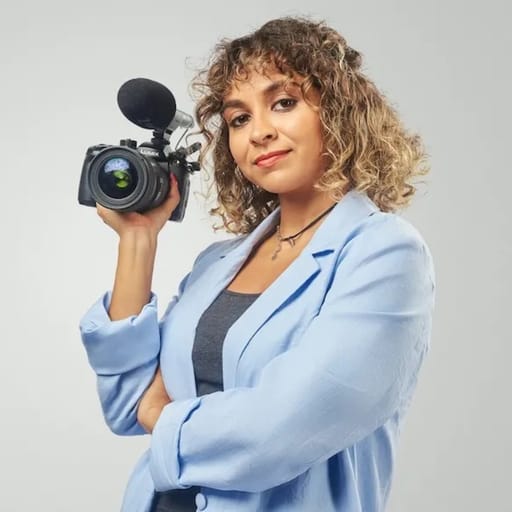
Transcript 0:00 [upbeat music] Welcome back to the Latino Newsletter Podcast. I'm your host, Michelle Zacarias, and our guest today is documentary filmmaker, Colette Ghunim. 0:10 Colette is a storyteller whose work spotlights experiences of displacement, migration, gender, and cultural identity. She is the co-founder of the Mezcla Media Collective. 0:22 Her breakout short documentary, The People's Girls, exposed the realities of street harassment in Egypt, earning international attention and the Arab Film Festival's Best Short Documentary Award. 0:33 She is now releasing her first feature length documentary, Traces of Home, which follows her and her parents back to Mexico and Palestine to rediscover the homes that they were forced to leave in their youth. 0:45 Thank you so much for being here, Colette. Oh, Michelle, I'm honored. Thank you so much. I'm so excited. You know, in Traces of Home, you follow your parents back to their homeland, right? For your mother, that's Mexico. 0:57 For your father, that's Palestine. 0:59 Um, and these are places that they were forced to leave when they were very, very young, so I know that this journey was emotional for everyone and also probably extremely cathartic in many ways. 1:11 But I wanna know, how did your parents first react when you proposed documenting their personal lives on film? Well, yes. 1:19 This is a big question, especially I think we can all resonate with our parents who are, like, children of immigrants and refugees of things are very private. We don't share our baggage to the world. 1:29 That is the quite the opposite [laughs] of what we do. And so when I first told my parents about this idea of going to Mexico and Palestine, it was very surface level. It was just about the trips. 1:40 So my mom was more open to it, and she was like, "Oh yeah, that sounds like a nice thing to go [laughs] nice thing to go back to Mexico." 1:47 [laughs] And I feel like she was much more open, but my dad was like, "There is absolutely no way." 1:51 And so it was difficult to get him to be convinced of the bigger reason why we would be doing this, and I think what really switched for him was when we actually started to show the trailer and inviting him to fundraising events and seeing how many Palestinians were so excited for him to take this journey back. 2:12 And so after some time and doing some more interviews, he started to get more and more comfortable with the idea of doing it, but they definitely did it for me, and I recognize that this was an act of love, uh, of saying yes. 2:23 Yeah, absolutely, and you can definitely see it as the film progresses, right? 2:29 You see a lot of that hesitancy, almost just, like, resistance, and then slowly as you're chipping away and rebuilding trust with your parents, there's just that, like, vulnerability and that willingness. 2:41 Um, and you know, I can't imagine for you, as you mention in the film, having felt, you know, kind of disconnected from your identities growing up in the suburb, how that was to be in those physical spaces. 2:55 And I wanted to ask, if you went to both Palestine and Mexico, 3:00 was there any specific place that you went to that felt like deeply resonating with you and your identity, where you're like, "Wow," like, "I'm home" or, "I... This feels like, uh, what I've been looking for"? Wow. 3:15 You know, it's interesting 'cause it's the place that wasn't even in the film [laughs], but we went to the pyramids in Mexico, like near, near Mexico City, and to feel like the sacredness of the culture of, like, the indigenous, it just, uh, something in being in that space was just, like, a, an overwhelming, wow, this is actually in my blood, this level of, like, deep wisdom and deep, uh, connection to the divine. 3:44 It was just really, really powerful. And so that was something I wasn't expecting, that, that feeling of connection to the land, and there was somebody playing, like, a wind flute that was just, like, out, [laughs] 3:55 out near the pyramids, and it was just, like, really, really so special in Mexico. I think that was something that really stood out for me. 4:03 On the other end, in Palestine, the moment that I really felt deeply connected was a place called Akka, which is in the occupied territories of, like, the '48 land, and, um, it's the only fully Palestinian town in what is now considered Israel. 4:21 And so all the food, all the people, everything was just, like, intact of what Palestine is and what could have been, and it was just, like, a, a beautiful experience and also, like, a lot of grief of being like, wow, what could be for our people that have been displaced on their own land, that have now had to assimilate with a new language and a new, uh, entire structure, which makes them second-class citizens. 4:46 There were a lot of really emotional, intense moments for your family as they're retracing their roots. They're revisiting the places that they were displaced from. 4:57 You know, I'm wondering for you, as this project progressed, this has been obviously a labor of love, but also sort of like a, a healing journey for you and your parents. 5:09 I'm wondering what's been the biggest way that your relationship with your own parents has changed since the start of filming? 5:16 I did not realize that Traces of Home was going to become the medicine that was going to be the actual tool to heal the dynamics within my own family, that by going deeper into asking these kinds of questions that I would've never asked without having the camera, that we were able to go into the tensions and the trauma and the pain in a way that I would not have been able to without the shield of using the camera to go deeper. 5:44 And so being able to learn about my parents' escape stories and also to learn about how their family and their parents impacted them, that it actually was able to create much more compassion within myself towards why my parents... 6:01 were the way they were. 6:02 That there was a lot of strictness and a lot of emotional walls in my home, and I didn't understand why that was, and I had so much anger and resentment just, like, inside of me because I felt like I could never be myself growing up. 6:15 And then I realized, oh, wait, there's this thing called intergenerational trauma as I started to go to therapy and starting to unpack that and realizing that this is not just about my family, but that there is an entire ecosystem of colonization and harm and violence that made us have to stay safe and in this bubble. 6:32 And so from working on this film with my family, we have been able to really mend the cracks that were in our relationships through very, very difficult conversations together, and really bringing up the pain that none of us really wanted to talk about or face. 6:53 And so I am really amazed and, like, just so grateful to say that, like, the relationship specifically with my mom has completely transformed since nine years after making this film, and I didn't even know it would be possible to have a healed, authentic relationship that lives in truth with her where I can show up as my authentic self, and she can show up as hers, too. 7:15 It's, uh, profound. Do you think that, like, Latino but specifically Mexican culture and Palestinian diasporas, like, mirror each other in terms of, you know, migration, loss, rebuilding community? Yes. Yes. 7:29 It's pretty amazing just how close, like, Latinx and Arab culture is, and I feel like that mix works so well because of all the similar values of, like, family and of, uh, this, like, really generous spirit of giving. 7:42 I feel like it's in both cultures. 7:44 And then also the side of, like, rich culture around dance and food, that there's just, um, so many parallels and overlaps in both cultures that, uh, they just, yeah, they just really meld well together. 7:57 And so I really like that this, like, film can also be a bridge for both to come together and see the similarities more than differences as well. 8:04 Are there any, like, practices or traditions that, like, your mom has taken from your dad or your dad has taken from your mom? Hmm. Hmm. Hmm. I mean, definitely there is some, like, food overlaps. 8:17 My mom has learned, like, a few dishes, like Palestinian dishes, and my dad... Well, 8:22 my dad was a wedding videographer, and he filmed quinceañeras and Mexican weddings for, uh, for his whole, like, career, and so he is sometimes even more Mexican than my mom it feels like. 8:35 [laughs] And he speaks Spanish fluently too. Yeah, I noticed that in the film too. I was like, oh my gosh, he did his homework. Yeah. 8:41 [laughs] Um, and I love also seeing exactly where your filmmaking roots come from, right? Like, it's so clear that your dad had this influence, and so even seeing how well documented your life was, um, is... 8:55 it's really amazing 'cause you have video footage for, like, everything. Um, I'm wondering- Mm... 9:00 like, for you, as a young filmmaker, I'm sure that's, like, an exciting thing, but as a child it must have also been really, like, I don't know, f- it might have felt, like, invasive at times. 9:09 Like, how has your perspective shifted on filmmaking since you were a kid? 9:14 You know, what's interesting is, uh, there is a line in the film that talks about this camera and this idea of the camera, and that it actually felt like my dad was more distant because he was behind the camera than it feeling, like, invasive, 'cause he was filming everything. 9:27 So it sort of became normal for him to always have his camera, like, attached to him, and yet there were moments where you could tell that he was sort of just, like, staying at an emotional safety level, not in with everyone and having to interact with everyone at birthday parties or at holiday events. 9:45 And so the film starts to go into that of, like, what was that emotional distance and what was he trying to protect himself from? 9:53 And it's that vulnerability and intimacy that, uh, is very scary [laughs] to be part of, and especially also with him not speaking English as his, as his native language, that he had a lot of, uh, feeling of disconnect with American culture or Americans too. 10:12 Yeah, and- Yeah... especially now, right? Like, there's so much that has changed around discussions with Palestine and Palestinian diaspora in the last, I would think, even five years. Mm. 10:25 Um, and I know that you actually started making this film before then. Um, 10:29 was there anything in the aftermath, I guess, of, uh, production wrapping up and the reception of the film that you were specifically surprised about or that you were, you know, I guess pleasantly surprised about? 10:44 Um, 'cause I know that you've received a lot of support now, and you have executive producers that are, like, celebrities, like John Leguizamo and Melissa Barrera. So how did that all, I guess, come to fruition? Yeah. 10:58 Wow. I mean, I guess this is more in, like, the filmmaker hat now, [laughs] of like doing, doing your art and making your project. 11:05 And so in the beginning, as I mentioned, this film has been a nine-year journey, and in the beginning it was just me. 11:12 And like I was part of a fellowship, so I did have a mentor that was helping guiding me through, and yet I was the one that was applying to grants, like getting all the interviews ready, filming, editing, trailers, doing all of the pieces that allowed me to learn about the entire process of making a documentary. 11:31 And it had to stay like that for like, I would say, the first five years before I brought on my editor, Sarah Mamoudi. And 11:40 from there, as we started to build out the rough cut and started to bring in, mm, the animators to like support my parents' escape stories, that the team started to grow once we started to have more content to show that, like, this is a viable tool, or like this is... 11:59 I don't wanna say product, but like there is something coming out of this, that there is an actual material here. 12:05 And so-From there, we were to bring on some bigger producers that helped with fundraising and getting those connections. 12:14 And then at the final, final stages when the film was finally at picture lock, that's when we were able to send the screeners for, uh, executive producers like John and Melissa to be able to come on board. 12:25 And so it was like this slow organic growth of building the team that in the beginning it may feel [laughs] you're just gonna be doing this alone forever. 12:34 But yeah, if there's any filmmakers that are also listening that just, like, keep holding on because it will grow organically. 12:42 Yeah, I appreciate you saying that because I think a lot of people don't really have a full understanding of how much work goes into- Mm... 12:50 the filmmaking process, whether it's a film or a documentary or a series, and everyone kind of just wants to, like, jump into the industry. 13:00 And there are so many great, like, independent projects that could be supported and built on, and I'm happy to see that the reception was so positive. I know you guys had the screening in New York. 13:13 Can you tell me what that was like? I saw all of the team come together. Your family was there. How was that experience? Oh my gosh, like, I, I feel so grateful. 13:24 Like, what a blessing that was to be able to have my entire family there and to have the whole team there, and there was really no better place we could have premiered than New York because it is the city of immigrants. 13:37 And so it was directly for the right audience, too, that, um, so many Latinx and Arab populations and then also just, like, immigrant... 13:46 children of immigrants that came through that, like, were ready to receive this soul medicine to go deeper into their own healing journey. 13:53 And so, um, it really felt like it was, like, my rite of passage almost, that now this film, I was creating it for so long, but now I realize that it was, like, I was just being used as a vessel for this medicine to come forth. 14:07 And now it has worked on me and my family, and now it's ready to go out for those who are ready to go deeper into their own healing. And so, um, it was just... 14:17 It was a profound, profoundly cathartic experience to see how audiences were able to just take it in so fully and also to, like, visibly witness their own transformation happening after the screening, that they were just, like, so deeply moved, um, to begin that healing process within themselves and for their families, too. 14:39 I wanna name that this must be a really scary and vulnerable moment to be Palestinian, um, in the public eye. 14:49 And, you know, I wonder if you've had any instances where you've, like, doubted or you've had concerns about, like, how people would be open to receiving this story and the honesty around displacement for Palestinians, uh, specifically your father in this circumstance. 15:08 You know, I think something that, um, has really given me a lot of strength is seeing the Palestinians in Gaza and what they have gone through, that, uh, the level of extreme violence and suffering that they have faced has made me feel like it is an obligation to do this, this project, that there is, 15:30 there is almost, like, a duty to my community to be able to preserve the history and the legacy of both my family, my ancestors, but then also those who are being literally erased off the map. 15:42 Um, that it felt like my privilege of being an American and doing it here, that I felt very... Yeah, that I just felt like with the level of grief and loss, that I was like, "You know what? 15:55 I-- This is the least I could do for what's happening in Gaza and, like, for Palestinians." And so, um, yeah, I think that that's what has really pushed me through to be like, um, it's not for me. 16:08 It's not about me anymore. It's for everyone, the collective. 16:13 And even just, like, for all of our collective liberation, both Palestinians and beyond, that we're all realizing that there's, like, a collective awakening of what colonization has caused, the level of harm. 16:25 And so, uh, it feels like it's a much bigger project than just about me anymore, that it, it just had to be made for everyone. 16:33 These stories that you tell are so important, um, because they are representative of so many people's experiences. Um, so I... 16:42 Yeah, I really loved and appreciate the way you went through kind of the storytelling process. 16:47 I have so many friends, so many colleagues, so many people that are so interested in documentary filmmaking, but I think there's so much, um, unknown about the process of it. 16:59 For someone who's, say, just starting off or doesn't have a large budget, what would you say is, like, the first tangible step to documenting a story that you feel is really important? Yes. 17:13 So that's a great question, and I feel like there's two things that are very vital at the beginning stages. 17:21 One is filling out the Documentary Core application because in that application, that's the grant application that all... 17:30 most, most of all grants use, and that goes through the entire thing of what's your logline, what's your synopsis, who's your target audience, what's your, um, artistic approach? 17:43 And with all those different questions, that's where you can actually start to brainstorm more deeply about what the film is going to become, and that was the practice that I did, of course, for grants but then also for myself to actually start to build out what the narrative structure of the film would be. 17:58 And then the second thing was creating a work sample. 18:01 So in 2016, I literally just, like, used, like, a very dinky camera and sat my parents down and just asked them a list of questions, and it's terrible footage, and I just, like... 18:13 Maybe I scanned some photos and took some videos of some photo albums, and that became the, the trailer for Traces of Home.And it is, it's rough. [laughs] It's real rough. 18:23 But it was a starting point, and that's how we got our first $5,000 grant to be able to create a stronger demo and to raise the money to go to Palestine. 18:32 And so I would say one is writing, and being able to really focus on your writing, and then just doing some, like, very, very preliminary interviews, not caring about... Well, maybe a little bit, but production quality. 18:46 It can be not so great. It's okay. [laughs] Yeah, and I mean, you ended up with a really beautiful high-quality trailer in the end, so you got to continue pushing- Yes... 18:55 that project forward along based on the initial step. 18:58 Um, you know, would you say there's any specific obstacles that you think people of color, whether they're Latino, Palestinian, or just women of color who are in filmmaking encounter, um, that you would advise people to be kind of mentally prepared for? 19:16 I think that now is a really beautiful time to be wa- making our art, because there are so many different supports of grants and fellowships, and I feel like people are just ready to hear our stories as BIPOC folks in the US, that there is a demand for this. 19:31 What I'm gonna say is actually I think that the biggest obstacle is ourselves, and our own self-limiting beliefs, and what we have been conditioned to believe that we cannot pursue our biggest dreams, our art, and our creative expression. 19:47 And so while of course, like, pursuing the production itself is very important, I would also say starting to do the inner work of, you know, going inwards of saying, "Okay, 19:58 um, I do have the ability to do this," and what is this imposter syndrome that might be popping up of is my story even worth sharing, or is this even possible to become a director or producer? 20:10 That those limiting beliefs have to be broken down for us to step into our power as artists and into our full expression. And so I think that is the most essential obstacle to break along the way. 20:25 Yeah, I think there's so many different methods of storytelling, too. Like documentary filmmaking is one. Mm-hmm. But you can write... And like you said, you have to be a good writer [laughs] either way. 20:36 So you can write it out, um, you can do illustrations, and just building community in those network of artists have been so life-changing. Um, you know, I know that you co-founded the Mezcla Media Collective. 20:53 Like, you've been in so many different pockets and areas of, like, different artist spaces. Um, we originally were introduced to one another through Chicago Artist Spaces, and then you actually moved to the Bay Area. 21:08 What... 21:08 You know, what had been the biggest artistic shift, I guess, moving geographically from place to place that you feel like has either propelled, uh, your project forward, or your career forward, or your artistic, um, endeavors forward? 21:21 I'm so grateful that I started in Chicago with this project, because the documentary community is so strong with Kartemquin, and with Mezcla now, and with, uh, OTV. 21:31 There's just, like, a lot of different media community groups that I feel really helped to incubate it at those early stages. 21:40 And, and that Chicago is very unique in that it is so collaborative, and that it feels like everyone is there to support each other, to uplift each other's films and each other's projects, which is not the norm [laughs] in the film industry a lot of the times. 21:56 And so Chicago is a very special place. I moved to San Francisco about three years ago, and it has also been a transformational experience to get to meet more filmmakers over here as well. 22:10 And of course, being so close to LA, there are some major national documentary orgs here, like the Bay Area Video Coalition, ITVS, um, SF Film. There's, there's some very big 22:25 organizations that I've learned so much from that have also helped to really elevate it to a much larger platform as well after launching in Chicago. 22:35 And also getting to meet documentary filmmakers in the Bay, it's also been really amazing, because it feels like they're very similar stories to Chicago, and yet something about the Bay and the nature that I feel like there's something different in the space here where there's, like, more of, like, a free spirit, hippie vibe that allowed me to go deeper into, like, the, the more abstract creative side of myself that I don't necessarily feel like I was doing that in Chicago as much, because it was much more, uh... 23:05 I don't know. 23:06 Something about, like, the industry, the, the urban city of Chicago versus being in the ocean, and the redwoods, and all of that opened up something, and it- that's what had me have a nature motif in the film as well. 23:18 Yeah. And, you know, I think you hit it right on the nail. Chicago is so community based and, uh, collaborative in a lot of ways. 23:26 But California, whether you're in the Bay Area or So- Southern California, will really push you to the limits, right? Like, it will chew you up and spit you out if you're not serious about your craft. 23:38 So, like, I have so much appreciation for both places, which obviously I've lived in. 23:44 Um, but yeah, it's been amazing to kind of see your project from Chicago to the Bay Area, and now, like, being released in, you know, places everywhere, and being screened in New York. It's, it's having this impact. 24:00 Um, what do you hope to see in the future for Traces of Home? Or should we be expecting other new projects from you? 24:08 It feels like, and I guess that's another filmmaker thing, is the part one of this whole process is just making the film. [laughs] That that's, like, halfway of the journey of filmmaking. 24:18 And so we're definitely gonna be on the festival circuit for the next-Six to eight months, and we recently partnered with Watermelon Pictures, who has acquired the film as well, and so we'll be doing a theatrical run hopefully around the end of next year to bring it to, like, major cities, and then bringing it online. 24:37 And there is also an impact campaign that is attached to the film as well, which is all around trauma healing for children of immigrants and refugees. 24:46 So we are doing somatic healing workshops for BIPOC folks around the country, and we did our first one actually for the New York premiere, where we had about 20 people of color come through and do some, like, somatic exercises and journaling and prompts to really start to unpack their own family stories and their own sense of home. 25:07 And so we wanna do the same thing around the US, and to help people guide into their own healing journeys as well. 25:14 And so I'm really excited for that, and that's where my heart is now after learning so much about trauma healing through this process, that I am actually right now going to get my somatic coaching certificate and going deeper into, uh, supporting those who are ready to deep... 25:30 dive deeper into their own trauma healing work as well. Wow, what an exciting endeavor. Somewhat related, but also feels like a completely different playing field, too. Right. Right. 25:42 Um, and do you see those as being, I guess, interconnected in your work? You know, the storytelling aspect and the traumatic healing aspect. Do those things feel like they naturally intersect for you? Yes. Yes. 25:57 So I actually... I studied psych and media in college, and so I was always interested in therapy, but didn't realize that the film I was making [laughs] was gonna become a therapy film. 26:06 [laughs] Like, that it actually became something around mental health and around, uh, using this film as a healing tool. 26:14 And I didn't realize that art could be that healing tool for others, and that for the trauma healing process to begin, we have to first know what's inside of us in the first place. And so 26:28 there's a something in the somatic coaching certificate called story shaping. And so we take, like, 20 minutes to share our stories of what has created us and what has shaped us to who we are today. 26:40 And I didn't realize that Traces of Home was my shaping story, that I was creating that the entire time. 26:45 And so being able to have the space to be able to unpack and dive deeper into our own origin stories, our parents, our heritage, that, uh, that's where you'll find the healing within yourself. 26:59 And so that's how I see the film doing that in the trauma healing space, too. Wow. Well, that's beautiful, and I'm really looking forward to seeing what else you create in the future. 27:10 Um, and of course, really excited to tell everybody to go watch Traces of Home. Will you be... 27:18 Uh, is there anything you wanna say, I guess, kind of to end the episode, um, anything you specifically wanna note about, like, either your journey or the filming process or just the attention that you wanna bring with the promotion of the film? 27:32 Yes, definitely. We definitely want to have a lot of community screenings and university screenings around the US. 27:37 So those who are interested in having a screening in their community, they can go to tracesofhome.com to request a screening, and we're starting to track for when it is done with the festival circuit to go out into the world. 27:49 And another big, uh, I guess, leap from Traces of Home is that I'm actually starting to create an online community and an in-person community called Coco's Sanctuary for those who are really ready to, like, go into their own inner transformation. 28:05 And so having workshops, having, uh, different offerings online and in person. So if people are interested in that too, they can also go to my website to go into that space too. 28:15 And I'll soon be offering somatic coaching once [laughs] I finish the certificate. Wow. Well, thank you so much for that, and I'm looking forward to seeing all of that manifest. 28:25 Colette Ghunim, thank you so much for being on this episode of the Latino Newsletter podcast. We are so excited to see your future projects and to watch your current documentary, Traces of Home. 28:37 Thank you so much, Michelle. Really, it's, uh, it's such an honor, and I'm so grateful for all the amplification of our stories that you all are doing. Thank you so much. 28:45 [upbeat music] This episode of the Latino Newsletter podcast was produced by Joaquin Kotler, Juan Diego Ramirez, and Michelle Zacarias. It was edited by Julio Ricardo Varona. 29:01 Music by Cast of Characters via Soundstripe. Season two of the Latino Newsletter podcast was made possible through individual donations and the Latino Media Consortium. 29:11 The views and opinions expressed in this podcast are those of the guests and host, and don't necessarily reflect those of the Latino Newsletter or its staff. [upbeat music]